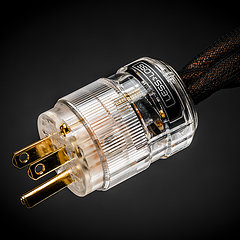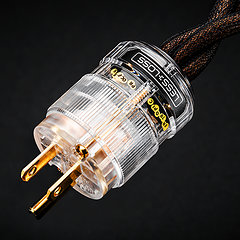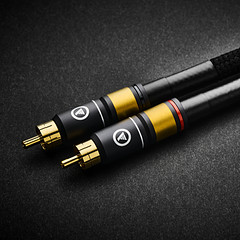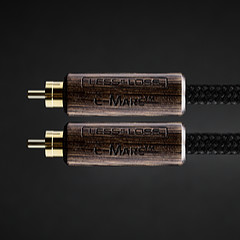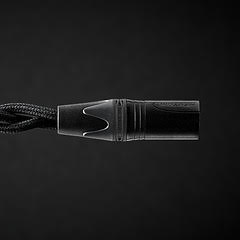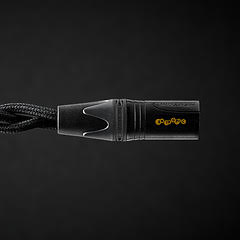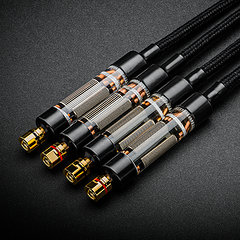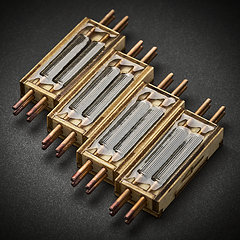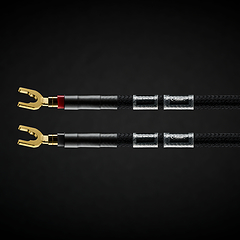
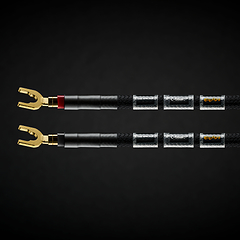
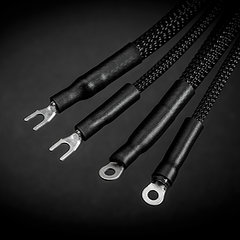
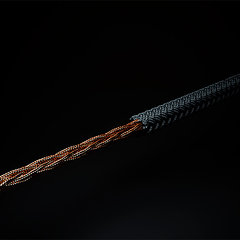
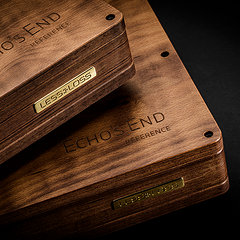


We Make Special Digital Cables.


We make cables which bring out the best our DAC 2004, or any DAC, has to offer. If you use any coax cable with the DAC 2004, you will already enjoy extremely high-quality audio playback. In order to achieve yet higher quality, it is highly recommended that these cables be used to limit the effect of radio interference.

We promote an open discourse about the methods and materials used to achieve the top possible signal transmission quality from point A to point B. Therefore, we have no inferior or superior 'lines' of products. When you choose any LessLoss solution, you are already choosing the best we can create.


LessLoss Digital Cables :: Features Overview

  • Coaxial topology.
  • Silver plated copper conductors for both positive and negative poles.
  • Silver plated screen.
  • Complete screen coverage.
  • PTFE dielectric (inner #1 -- between positive and negative conductors).
  • FEP dielectric (inner #2 -- between negative conductor and shield).
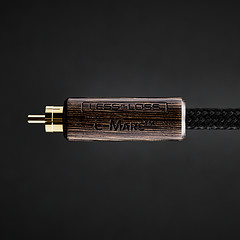
  • Eichmann Bullet RCA connectors, anodized aluminum housing.
  • Price for S/PDIF cable, when purchased separately: 275 EUR (includes worldwide shipping).
  • Price for clock cable, when purchased separately: 275 EUR (includes worldwide shipping).
  • Price for S/PDIF and clock cable, when purchased together: 400 EUR (includes worldwide shipping).


LessLoss Digital Cables :: Pictures

  • Many cable manufacturers use the marketing term "95%" or even "100%" to lead the consumer to believe that no electromagnetic interference enters the cable. This is not true. The true measure of a cable's ability to attenuate EMI is called Shielding Effectiveness (SE), which is expressed in decibels (dB), the ratio of field strength on the outer side of the shield to the inner side. The former LessLoss solution to good shielding was to combine both extremely tight coverage and the use of ten shields. View our former shielding coverage in a 1:1 comparison to a proudly marketed "100%" shielding. The scale is in centimeters. If you bother to count the windings you will notice that the outer-most shield alone contained roughly the same amount of metal in 2 mm as a standard cable uses in 10 mm. You are viewing only the outer shield of the older modification LessLoss cable, but there were nine others underneath.
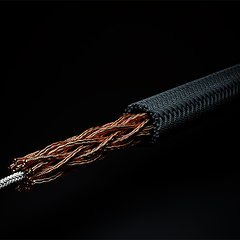
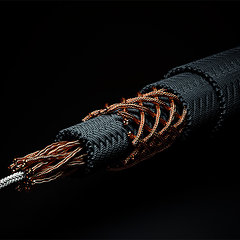
  • Instead of showing you an exaggerated schematic of the cable's construction, here we show you the guts themselves. The ten protective shields were separated from the negative pole of the digital line by PTFE (Teflon). A cross-section view of the cable on axis.
  • Floating shields means that they are not electrically connected to the signal line. In the LessLoss Digital Cable of former design, the shields are floating. This frees the digital schematic from unwanted radio signals, and protects the line from the influences of radio frequencies to produce jitter. Is this audible? Very! See how the floating shields looked.


Today's LessLoss Digital Cables :: Redefining the State-of-the-Art

Standard shielding makes use of braided conductors. This allows for flexibility of the cable. However, a shielding compromise inevitably occurs when using a braided construction: the countless crossing points of the wires create not only a matrix of shielding, but a matrix of holes. These holes cannot be compltetely covered up even with the use of ten braided shields. There always remains an angle between the braided wires, and this angle results in unavoidable pores in the shielding.

The alternative that LessLoss now employs is to tightly wind a large-diameter wire around the signal carriers to be shielded. Between the individual twists of this wire, inevitable valleys form which will have small spaces between them when the cable is flexed. To alleviate this problem, a second layer of wire is again helically wound very precisely over the first, carefully placed in the valleys formed by the first layer of winding. The result is that not only is the signal completely protected from interference, but that the protection is even bettered through the flexing of the cable, as the friction of the two wound layers of wire causes the second layer to press tightly against the valleys of the first!

In addition to this perfection of shield design, the wire used is silver plated. This forms a very conductive barrier between the metal conductor and the electromagnetic field surrounding the shield. The exposed nature of the shielding is yet another advance in that no additional dielectric deformation of the signal's waveform takes place.

LessLoss Digital Cables :: Pristine Signal Transfer

At low frequencies, circuit theory is generally adequate to explain the behaviour of collections of electronic components interconnected by wires. The wires are said to be non-reactive. As frequency increases, the energy transmitted is stored closer to the edges of the wires. This is known as the skin effect. At yet higher frequencies, energy is also held in the space around the wires, in their magnetic fields.

In the transfer of an S/PDIF signal through a cable, what we are in effect doing is transmitting a low-level radio signal along the outer edges of the wires in the cable. Coaxial cable geometry is used in high-freqency signal transfer because it has a characteristic impedance.

As we are interested in extremely high performance signal transfer, what we are up against is an aether which is practically saturated with radio waves at all frequencies. We must bring our signal unharmed through this aether.

Radio waves are parasitic to our cause because the energy in the S/PDIF signal reacts to the energy in the radio waves via induction. When the two signals meet, this results in unpredictable intermodulation distortion of the digital signal. Although this distortion is not enough to cause data fallout, it does indeed affect the timing information of the digital signal. Timing errors in the digital domain are known as Jitter.

The reason that such extreme shielding is used is to fascilitate the pristine transfer of a sensitive radio frequency signal through a medium infested with other radio frequencies. The shielding effectiveness of the LessLoss digital cable is extremely good. The turbulent RF situation on the outside of the shielding no longer exists within, where critical timing information of the S/PDIF signal passes through our prepared 'pipe' of calm electromagnetic conditions.


LessLoss Digital Cables :: Summary

  • 75 Ohm Impedance Cable (less undesired signal reflections)
  • Highly effective shielding (less undesired signal distortion)

The result of this is that the LessLoss Digital Cables transfer digital signals with minimal loss of timing, which is the crucial aspect of real-time digital signal transfer quality.


Newly developed LessLoss Digital Pipes :: An even better solution

When a client orders a LessLoss customized and slaved CD player, our best possible digital connection is offered. This is a set of entirely non-flexible digital tubes, bent in-house to fit the exact configuration in which they are to be used. The tubes are silver plated thick-walled copper and the outer surface of tube is highly polished, resulting in the most protected clock and SPDIF data transfer. Eichmann Bullet connectors from Australia are used. The price for both necessary digital connections is then only 200 Euros. This price includes both necessary digital connections for our best synchronously slaved CD player solution.

Click for more detailed image.

Digital Tubes :: How they are connected.

To connect the digital tubes, the slaved Rega CD player is placed on top of the DAC 2004. Both ends of each digital tube are inserted into the gear simultaneously. The result in terms of Jitter of this type of connection is that, in effect, both the sensitive high frequency clock signal and the SPDIF return data signal practically never leave their respective circuit boards. At the same time, due to their distance, the DAC circuit board is completely isolated from any and all interference from the CD player's circuitry.

Click for more detailed image.
Newly developed Flexible LessLoss Digital Cable :: Our best coaxial digital cable solution

We have further perfected the timing of the digital transfer through the development of more effective gigahertz shielding using proprietary carbon based materials tightly braided with copper and submerged in a semi-conductive fluid. Ferrite rings at both ends of the cable are added as well. The resulting RF-impregnable "coat of arms" is extremely effective well into the multi-gigaherz region -- which is very important and very audible in digital audio transfer. We now offer this standard 1-meter flexible directional digital cable for 225 Euros. No traditional offering can compete in terms of sound quality and signal transfer integrity.

Click for more detailed image.

What you should know before buying a DAC:
( PDF Version )


DAC 2004 :: List of Features


LessLoss Cables


Pictures


Reviews


LessLoss Recordings!


LessLoss Pricing + Contact Info


Can't find it? Search here.


© 2004-2007 LessLoss.com [All rights reserved]