

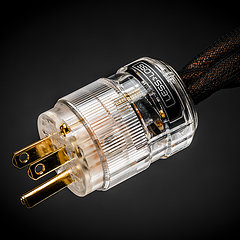
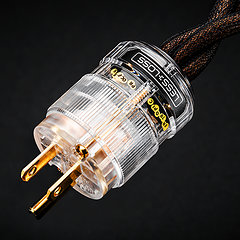
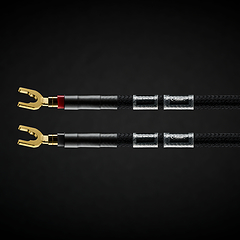
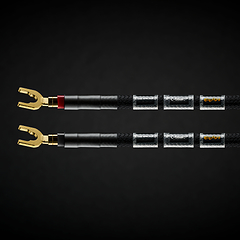
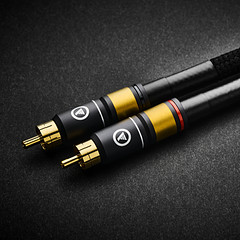
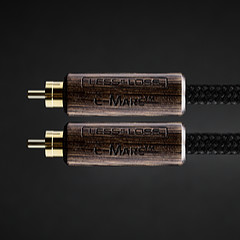
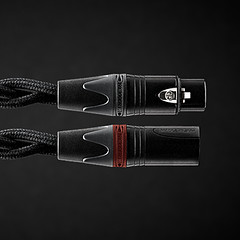
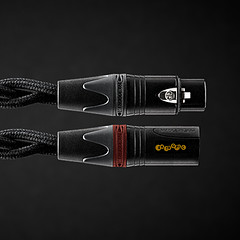
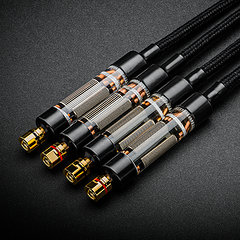
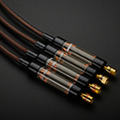





C–MARC™ Loudspeaker Cables
Common-mode Auto-rejecting Wire and Cable Products


Introducing C-MARC™. A new generation of high-performance wire and cable, well equipped to deal with todays over polluted electromagnetic environment.
C-MARC™ is a new type of Litz wire. C-MARC’s noise reduction is based on the bucking coil method using two counter-polarised coils. Every strand's clockwise turn aligns with a corresponding counter clockwise turn of precisely mirrored diameter and step. The two, resulting counter-polarised coils are mutually superposed. A second-scale fractal replication of the already bucking coils is then repeated. Through electrical cancellation of the induced noise, C-MARC™ provides an enormous signal-to-noise ratio in today's demanding audio environment.
- Superposed bucking coil geometry
- Two-scale fractal braid structure
- Low resistance
- Highly flexible
- Very lightweight
- Effective vibration damping
- Mercerized cotton for a satin look
- Aged via cryogenic treatment
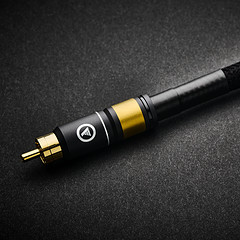
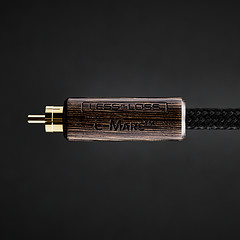
- Gold plated copper contacts
- Quieter background
- Higher resolution
- More neutral timbre and focus
- Pinpoint accuracy on realistic soundstage
- Natural dynamics
- Potent transients
- Relaxed, natural listening experience
- compromised dynamics
- listening fatigue
- cable drawing attention to itself
- bloating image out of proportion
- artificial 'embossing'
- never harsh
- brittle 'hi-fi' sound, headache


Entropic Process: A LessLoss technology most profound
Pictured below is the new insignia of the ultimate LessLoss achievement. When you see this symbol, you can rest assured that sonics don't get any better than this!

We have been investigating the mysterious burn-in phenomena for the past 20 years, following it very closely and learning ever more about it. Finally, we have figured out a way to actually use it in the design of an actual product. This has been on our creative minds ever since day one when we first experienced burn-in decades ago. But the secret within has remained elusive to us—until now!
This does not mean we have abolished all initial changes in sound quality. It only means we have developed the means and methods to accelerate it—pre-prime it, so to speak—to the point where, in your first two weeks of listening, you might go through some 200 years of regular burn-in. The burn-in process has not been disposed of by us but rather put into overdrive in order to serve listeners even better! This is the genius of our new Entropic Process.
To fully comprehend the concept behind it, prerequisites are in order.
If you have never experienced any strange burn-in effects…you will not yet know that of which we speak. The strange burn-in effect remains, undoubtedly, the most mysterious of all aspects involved in high-end audio. Appreciated, experienced, and accepted by thousands, yet understood by none, it remains an uncracked code of mystery which has represented a strange bottleneck to designers until now. Sometimes it is a cause of ridicule, but sooner or later everyone experiences it…and suddenly that voice of ridicule is noticeably quiet.
What is burn-in?
Burn-in is a strange phenomenon in which newly made gear or cables go through a series of inexplicable initial transitional phases in terms of performance. One day the sound may be brittle and coarse; another day the sound may be rubbery and elastic. One may experience phases of bass-heavy submersion as if one is under water, then periods where one feels the bass is too weak or not in balance with the mids and treble. Eventually, these two extremes converge into a balanced, stable performance, a mature and pleasant tonal balance.
This process is dependent on two things.
First, much depends on total system transparency. If the system has deep flaws, such as being located in a room with ceramic tiles and many exposed glass windows, of course an acoustic echo chamber like that will mask such effects greatly. However, if the system is set up well in an acoustically well-organized space, you'll hear the flaws with ease.
Secondly, it depends on how sonically neutral the fresh product actually is. If it is severely skewed in some arbitrary tonal direction, it will be more difficult to sense just what is going on in terms of this burn-in process. An example of this is found in multi-strand copper conductors with silver plating. But if a product is a sonic giant in terms of its ability to present exactly what is taking place in the recording, without editorialising, one will hear huge burn-in swings initially.
It is most likely that LessLoss products present exactly the same changes that any new wire goes through. The only difference is that C-MARC has such a fantastically low noise floor that one can more readily perceive and experience these large burn-in swings because so much more detail is exposed to the listener than usual. It goes without saying that you simply cannot have it both ways: you cannot expect a totally transparent cable to reveal real data on a recording that won't simultaneously also reveal a much deeper underlying physical aspect of burn-in as it matures and settles in performance. The performance is the ability to show more and more minute changes in signal. This also must mean, at the same time, that it will show more and more minute changes in whatever actually constitutes burn-in (molecular structure re-alignment or something…? sorry, we haven’t solved everything!).
And a mystery it is and remains.
But we have made a HUGE step in accelerating it.
If, before, you experienced the infamous ‘roller-coaster ride’ of settling and opening up, now it will be a supersonic rocket launch with G-forces you had better be prepared for. After the rattling of instruments, mind, muscle and bone, the view, once in orbit, of that rarefied silent cosmos, is really worth the patience. Burn-in time is not necessarily longer or shorter…it is just more intense.
Both the C-MARC™ power cable and C-MARC™ Entropic Process power cables are superb performers. It takes us 18 hours to make the C-MARC™ power cable and no less than 30 hours to make the Entropic Process version.
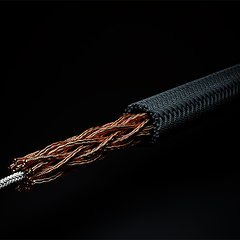
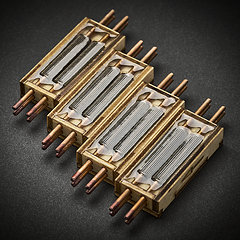
Build of one polarity of the C-MARC™ Classic loudspeaker cable
All strands pictured below are electrically connected at both ends of the loudspeaker cable per polarity. One stereo set is made up of four such assemblies. One for Left channel positive, one for Left channel negative, one for Right channel positive, and one for Right channel negative.
The LessLoss C-MARC™ Loudspeaker Cable comes in four individual runs of cable. These are (1) Left channel positive (red), (2) Left channel negative (black), (3) Right channel positive (red), and (4) Right channel negative (black). For these runs, we us our coaxial cable, electrically connected such that both center conductors and outer connectors are all mutually electrically connected at each end, resulting in a whopping 4.6mm^2 cross section of conductive material per polarity. Our Jumper Cables are made in the same fashion, from the same materials.

Mercerized fibre is stronger and displays a smoother appearance. Because the stucture of the fibre has changed, the braided structure reflects light more readily and has more lustre.
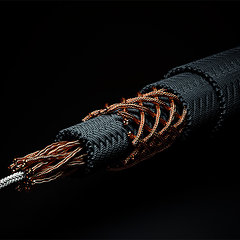
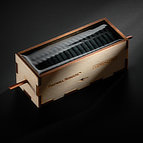
Build of one polarity of the C-MARC™ Stellar loudspeaker cable
All strands pictured below are electrically connected at both ends of the loudspeaker cable per polarity. One stereo set is made up of four such assemblies. One for Left channel positive, one for Left channel negative, one for Right channel positive, and one for Right channel negative.

Mercerized fibre is stronger and displays a smoother appearance. Because the stucture of the fibre has changed, the braided structure reflects light more readily and has more lustre.
C-MARC™ stands for Common-Mode Auto-Rejecting Cable.
C-MARC™ is unlike any other hook-up wire or cable currently produced. It is based on the bucking coil method of noise reduction, used most famously in twin coil pickup designs first developed in the mid-1930s to silence hum from electric guitars.
This type of guitar pickup was called ‘the humbucker’ because it 'bucks the hum', i.e., noise, out of the desired guitar signal through phase cancellation of two counter-polarised inductors. When the inductors both induce a common signal, it is induced in opposite polarities by each coil. These opposite polarities then mutually cancel when the two counter-polarised noise currents are combined through simple electrical summation. Humbucking coils are also used in some microphone designs, as well as in sensitive sensor technology where induced stray noise is not acceptable and the highest signal-to-noise ratio is desired.
LessLoss designs a new type of wire around the humbucking principle.
C-MARC™ wire is a special type of Litz wire. It features all of the known benefits of traditional Litz wire, but without the disadvantage of being formed as an elongated coil (inductor).
Traditional Litz wire has the following advantages over normal 'naked' multi-stranded wire and solid core wire:
- Litz wire has a greater ratio of surface area to cross sectional area, resulting in less phase smearing between lower and higher frequencies.
- Litz wire creates no distortions due to so-called “strand jumping” or diode effects resulting from loosely contacting oxide layers of adjacent naked strands.
- Litz wire is more flexible, practical, and safer than solid core wire of the same large cross-sectional area.
C-MARC™ wire shares all of the above advantages of traditional Litz wire and advances the art with these additional unique benefits:
(1) Traditional Litz wire is bunched and then twisted in only one direction, leading to the formation an elongated group of uni-directional coils (inductors) of differing diameters, its structure resembling elongated overstretched springs of different sizes.
[Fig. 1.: Sketch of typical Litz structure where multiple coil diameters and single coil turn direction resemble several overstretched springs bunched together. This structure allows high speed of production.]

[Fig. 2.: Each long separately insulated Litz wire can be seen as a separate coil of a given diameter and step. The different diameters are a result of the bunching before mutual twisting.]

[Fig. 3.: Individual wires of differing thicknesses are bunched together to form different geometries. Many variations of the Litz structure exist, most of which are based on the main idea of first bunching and then twisting into spirals.]

[Fig. 4.: Some manufacturers offer braided Litz wire, so-called “Type 7” Litz. This wire also is formed from initially bunched and mutually twisted strands before braiding. This type of wire is compressed after braiding the twisted bunches into an overall rectangular shape before tape wrapping and over-extrusion.]

How C-MARC™ is profoundly different
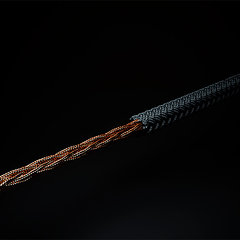
In contrast, C-MARC™ wire goes down to the very fundamentals in a completely mirrored, balanced geometry. It aligns every Litz strand's clockwise turn with a corresponding counter clockwise turn of exactly mirrored diameter and step along the length of the wire. These two resulting spirals are mutually superposed in counter-braided fashion. Noise is thus induced in exactly opposite polarities and in exactly mirrored amplitudes, while the good signal is common to both spirals. The two counter-polarised noise signals mutually cancel when the two counter-polarised currents are combined through simple electrical contact at both ends of the wire. Thus, through auto-rejection of opposing electrical phase through summation at the ends, C-MARC™ wire perfectly counters the noise induction, whether from external sources or self-induced, which normally pollutes every other twisted Litz wire assembly. In this way, C-MARC™ wire achieves signal transfer which is corrupted substantially less than the industry has been able to achieve through other means.
[Fig. 5.: C-MARC™ Litz schematic layout. The clockwise and counter clockwise spirals are mirrored in diameter, step and wire gauge, while at the same time superposed in relation to one another. This results in opposite phase induction within the very structure of a single polarity line. While production speed is substantially slower, the silence of operation of C-MARC™ wire is far superior to standard Litz structures.]

(2) This is not all! LessLoss C-MARC™ wire features two-scale ‘fractal’ replication of the aforementioned mutually superposed counter-twisted layout. This mirrored and nested structure further enhances the mutual cancellation of counter-polarised inductive twists, while at the same time allowing enlarged overall cable cross-sectional designs which serve to further lower resistance without any sacrifice of signal fidelity or flexibility.

[Fig. 6.: C-MARC™ shown in two-scale fractal replication. Everything that occurs geometrically at the core level is repeated again at the larger level, thus further reducing the induction of noise. Just as the initial clockwise and counter clockwise spirals are mirrored in diameter, step, and wire gauge, while at the same time superposed in relation to one another, so too at the larger level. This makes the cable a silent performer without influencing the natural tone colour of sensitive signals throughout the frequency spectrum.]
What this means
C-MARC™ is intrinsically the most silent wire on the planet and provides pure transmission of signal. The degree of silence of the working solution is in direct proportion to the degree of superposition of the counter-polarised twists, as well as in the degree of their mirrored equality in terms of turn radius, step, and resistance. The idea being that in the best of worlds, both opposite ‘polarities’ of a single lead of C-MARC™ wire induce the exact same noise, and a perfect summation to zero will result at both ends of the line.
(3) Because the individual enamelled wires which make up the unique Litz structure of the C-MARC™ wire are so small in diameter (0.125mm), the ratio between total surface area and total cross section is further enlarged for an even better phase relationship across the entire spectrum.
(4) This structure further enhances flexibility and ease of bed on any axis, especially for large cross-sectional cables, without unnecessarily enlarging the entire cable assembly.
(5) The strands used in C-MARC™ wire are covered with the thinnest technically possible colourless enamel. They are solderable once tinned in a soldering pot.
(6) There is no plastic at all; instead, C-MARC™ wire and cables are insulated with tightly braided, 100% natural, gassed, and macerated cotton fibre with double coverage for added protection. This results in a very lightweight, highly flexible, natural-sounding product with today's best performance characteristics for delicate audio applications with an enormous signal-to-noise ratio.
What can I expect in terms of sound?
Well, you won't hear coloration, that's for sure. You will however hear a lot more of the music's expression and true content. Click here for a bunch of reviews which will show you how various people in the press and users have expressed what they have discovered using C-MARC™!
Electrical connection of C-MARC™ loudspeaker cable
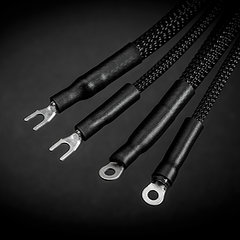
C-MARC™ loudspeaker cable is connected electrically with every strand of the C-MARC™ Bulk Coaxial Cable connected at both ends and terminated with either spades or bananas. This results in a total cross section per polarity of 4.608mm^2. In the case of the Stellar version, this results in a total cross section per polarity of 7.016mm^2.

The results are an unbelievably low noise floor, supreme sonic purity, and a very high accuracy of timbre from bottom to top.
C-MARC™ Loudspeaker Spade Dimensions

Custom cable solutions featuring C-MARC™ Wire and Cable
We gladly offer custom cable solutions using the highly versatile C-MARC™ wire and cable products. Among our possibilities are the use of:
C-MARC™ Hook-up wire, Small: 0.864mm^2 cross section
C-MARC™ Hook-up wire, Large: 2.304mm^2 cross section
C-MARC™ Coaxial Cable, adjoined at both ends: 4.608mm^2 cross section
C-MARC™ Stellar Coaxial Cable, adjoined at both ends: 7.016mm^2 cross section

As an example: pictured above, a set of 25cm length high performance loudspeaker jumper cables using C-MARC™ Coaxial Cable, all strands electrically terminated at both ends with bananas. These jumpers feature 4.608mm^2 conductive cross section each, unbelievably low noise floor, supreme sonic purity! Price for such a complete stereo set: 680 USD. Entropic Process version: 1168 USD. Stellar double Entropic Process version: 2009 USD. These prices include international express delivery will full up-to-date tracking.
Versions with spades or spade/banana combinations are also no problem. Just let us know what you need. (Today these spades will be delivered gold plated.)

How does the new C-MARC™ Speaker Cable compare to the Anchorwave and Homage to Time?
The tonal character of C-MARC™ is more liquid, fluid, and resolves more detail from any recording. As good as the Homage to Time is, it is still made of plastic (albeit very high quality plastic with excellent characteristics). Over and beyond the improvement in C-MARC™ that it is made entirely of cotton and a very thin layer of clear lacquer instead of plastic, the extremely well balanced counter-polarized coil technique lowers the noise even further than the methods employed in Anchorwave and Homage to Time, so the overall result is one of both lowered noise as well as one of purer tonal character. It is very easy to recognize these improvement straight from the start, even without burn-in.
After about 14 days of settling, the sound quality becomes even more organic and life-like. C-MARC™ is here to stay for a very long time. We feel confident that after a few years it will be recognized and employed in many different manufacturers' loudspeaker and equipment as internal hook-up wire.
One further advantage of C-MARC™ over both Anchorwave and Homage to Time is its extreme flexibility and light weight. Thus, even sensitively placed lightweight gear has the very best conditions to maintain the fine vibration control of even the most delicately positioned special tuning feet. See the following image for an idea of C-MARC™ cable's flexibility.
