







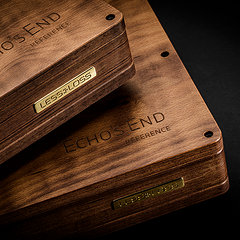

Ambient field conditioning A new approach
Until recently, the audiophile community has underestimated the relevance of near field electromagnetic (EM) interaction to audio reproduction quality, specifically to the coloration of sound. While audiophiles generally agree that objects like racks, stands, and equipment feet influence sound quality, it is also widely believed that this influence is only vibrational (mechanical) in nature. According to our own research, a significant source of that coloration is actually not physical in nature, and is due instead to near field EM interaction. After we explain what kind of tests we carried out which led to this conclusion, we’ll go on to postulate that indeed any object in the vicinity of your gear’s circuitry influences the resulting sound quality to some degree, even without making physical contact with it. We’ll then segue into the basics of electromagnetic radiation and how this relates to high end audio. By that point, the problem of EM interaction will be obvious and we’ll then explain what makes the Blackbody a uniquely effective and elegant solution—one that offers audiophiles a new level of accuracy in audio reproduction.
Nearby objects and sound coloration: what’s the connection?
How can it be that physical objects, just by being in proximity to your gear’s circuitry, influence audio reproduction? How can the mere presence of a component’s lid, equipment feet, or rack and the like, audibly color the sound—especially if the circuitry is not directly involved?
The standard audiophile answer:
To find the link between your circuitry and nearby objects causing sound coloration, an obvious place to start looking would be the influence of speaker vibration. First, through airborne sonic vibration (sound pressure levels in the air produced by moving speaker cones cause nearby objects to resonate like a microphone), as well as structurally coupled vibration through the floor (when your speakers play, their movement also transmits vibrations directly through the walls of the speaker cabinet, through the floor, into your rack, and from there to your components and their circuitry). In both cases, your gear is influenced by speaker vibration that permeates sensitive operating circuitry, creating unwanted microphonic signals there. These parasitic signals are then amplified and degrade the resulting sound quality in an acoustical way from speaker to electronics and back again through the speaker. A simple light tap on any tube of a tube amp will instantly show this.
Naturally, then, we do all we can to deal with these physical vibrations, hopefully without at the same time introducing objects that degrade audio fidelity in some other way.

Myriad solutions now exist to influence acoustic interaction. The embarrassing thing is, when listening through headphones, they’re just as effective. This makes one wonder: is it really just acoustic interaction?
Something we audiophiles have been missing:
While LessLoss acknowledges the role acoustic interaction plays in sound coloration, we also know that this cannot be the entire story. The idea that all of this is due to acoustical microvibration alone is false, because, when the equipment is acoustically isolated, the problem still persists. The headphones test proves it. Using headphones instead of loudspeakers brings the equipment and any vibrating surrounding objects into complete acoustic isolation from one another. (If there’s a buzzing transformer in your gear, then this becomes a more complicated story of course). Testing under these isolated conditions makes it obvious that while manipulating the objects around the circuitry, and without even any contact between the circuitry and the objects, the varying coloration in sound persists. This can only be due to something inherent in the physical surrounding objects’ proximity to the gear. To understand how this works requires a short discourse on the topic of electromagnetic radiation.
EM radiation: the basis for this interaction
EM radiation is energy with electrical and magnetic properties that travels in waves. These waves are produced by moving charged particles. Since all things are made up of charged particles, every object radiates EM energy (unless at absolute-zero temperature). Matter also selectively absorbs and reflects EM energy, and each material’s EM absorption and reflection pattern is distinct. All matter has its own fingerprint, a type of pattern called a spectral signature of radiation. These patterns are so distinct, scientists can identify the elements of nature from these unique spectral radiation patterns alone. Even the atmospheric composition of distant planets reveal themselves in this way.

Taken in perspective, we live in a world full of complex EM interaction. Objects absorb and reflect EM energy twenty-four hours a day, and the vast majority of it we don’t even see. The things we can see, we see only because the objects in question reflect EM energy at frequencies our eyes happen to be tuned to. Even more peculiar is that EM waves don’t always travel in straight lines. Your cell phone, for example, can still communicate with a cell tower, despite the large building standing between your cell phone and the tower.

In our world, where EM radiation permeates the physical domain, objects constantly interact in ways we’re often completely oblivious to.

So what does EM radiation have to do with hi-fi?
Quite simply, different materials proximate to your circuitry will affect that circuitry. Your component enclosures, equipment rack, scattered CD collection, and all other objects in the room—including the chemical composition of the air surrounding your circuitry—are active participants in the shared EM ecosystem. In this mutual network of interaction, the EM radiation emanating from your gear interacts with all other objects’ absorption and reflection patterns in a complex fashion, much like the complex echo and diffusion of sound waves from various objects in a church, only much more quickly, to the point of occurring practically instantaneously.
 initial radiation of EM energy
 re-emission (reflection) of EM energy

Since objects always selectively absorb and reflect EM radiation, leaving their own spectral signature in the reflection, they affect your component even if its circuitry doesn't directly "see" these colored reflections. The coloration we speak of is low level: it does not cause grave distortions such as data-fallout errors (although this can occur with the introduction of too much near-field UV light, for example). But its presence is palpable even with nearby objects which electromagnetically interact with the gear in only a passive way by means of their own distinct reflection pattern. The easiest way to convince yourself of this is to take your entire CD collection and place it all around your system, as close to your electronics as possible. Have a listen. Then remove them as far away as you can. Listen again. When they are moved away, the sound substantially clears up due to the absence of multitudinous and haphazard EM reflections from the metallized discs which were placed all around your gear.
Matter in proximity to audio gear smears the timing and focus of delicate audio signals, raises the perceived noise floor, and adds a distinct coloration which manifests itself as a sort of sonic sameness which simply doesn’t go away from recording to recording.

This explains what the audiophile community has for the longest time found very puzzling: circuitry enclosures of equal design, but made of different materials, somehow manage to cause undeniable differences in playback quality. Much emphasis is placed on build quality in high-end audio because all aspects of equipment design influence sound quality. Now, armed with our working theory, we can see that this difference in sound is due to EM interactions between signals and enclosure materials with different spectral signatures. We now have a good explanation for why we have felt the need to introduce talismans, or tweaks of mahogany, tourmaline, smoky quartz, and other such items placed in strategic locations throughout our systems. Typically, this specially balanced configuration in a highly tweaked out listening room takes years of trial and error to achieve. No wonder: there are so many complex EM interactions to account for.
Faced with a clear problem that manifests in such complexity, shouldn’t there be a more elegant, more accurate way to control this ambient EM labyrinth of interaction?
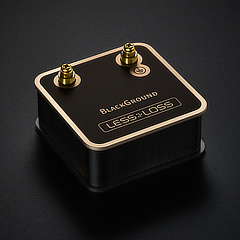
Our solution The Blackbody
Now that we have a clear description of the problem, it is not difficult to say what the ideal solution should do. It should prevent EM reflections from interacting with component circuitry signals, just as in our previous example the use of headphones prevented acoustic interaction. This is precisely what the LessLoss Blackbody does. It is modeled after the perfect blackbody—a hypothetical object from physics. A perfect blackbody would be an object that perfectly absorbs any EM frequency.

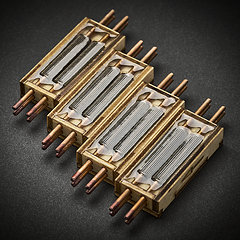
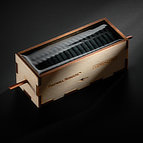
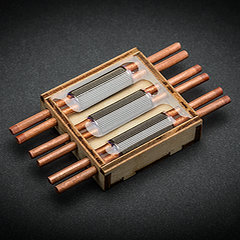
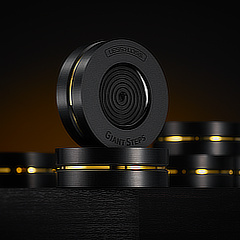
You can see how the blackbody got its name: by absorbing any EM wavelength, and by radiating none in our visible bandwidth, the device is as black as black can be; you might even say it is blacker than black, since it’d be the absence of light radiation altogether. Our version of the blackbody contains no power source or circuitry of its own; instead, the device itself is a specially formed array of concentric reflectors whose emission pattern in total approaches that of the ideal blackbody radiator. By creating this near perfect blackbody, we’ve created a device that, simply by being placed in your gear’s proximity, will absorb a substantial portion of radiation at that location. There, gear will no longer be able to bounce EM radiation off proximate objects, only to have it return to influence its delicate signals and degrade sound quality. The Blackbody’s EM radiation pattern lacks a distinct spectral signature.

This is not your typical "talisman" tweak. Such tweaks are accompanied by diminishing returns once coloration sets in. The Blackbody, on the other hand, is the only object that removes the influence of near-field EM reflections. Unlike other tweaks, it lowers the system’s noise floor, yet at the same time does nothing to introduce its own color the sound.
Positioning the Unit For top perfomance
Grounding the Blackbody
The Blackbody comes with a grounding option. See image below.

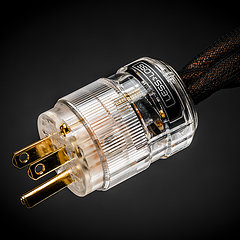
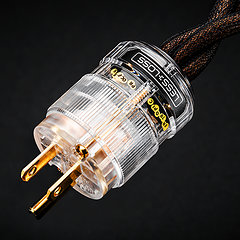
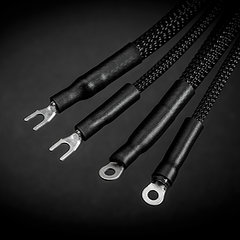
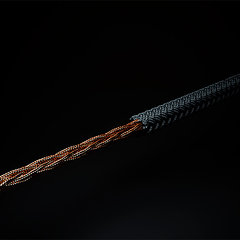
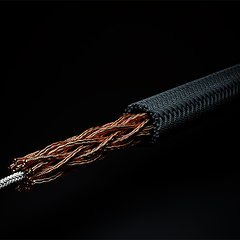
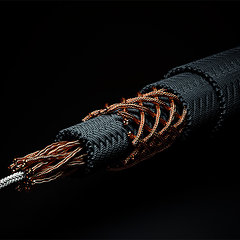
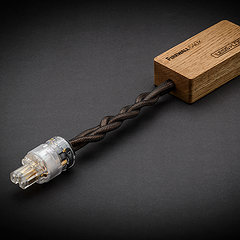
On the side of each unit is a small mounting screw [1]. LessLoss makes custom length grounding cables out of C-MARC™ wire [3]. These are terminated on one end to an M3 size silver plated ring terminal [2] and to the other with a high quality wall plug [4]. The grounding wire is connected only to the ground pin of the wall plug [4]. The other two power pins of the wall plug are not connected electrically. In this way, one can easily ground the Blackbody using any available grounded wall outlet [5].
The ground wire is very lightweight and extremely flexible, making its installation very easy under any circumstances. The Blackbody grounding cable comes in two sizes (Large and Small) and in various lengths.
Grounding multiple Blackbodies
A ground wire option with ring terminals [2] at both ends is available in order to chain two Blackbodies together.

In this way, only one ground wire with wall plug ending [3] is necessary and only one wall socket [5] is thus used.
Additional Blackbodies can be chained together using additional ground wires with ring terminals at both ends.

Some pointers on installation
One uses the tool above (pressing the "SHOW ME HOW" button) to determine the angle of the stand needed at any specific place on earth. It is very easy to use.
How many Blackbodies v.2 should be used in a given system?
Please note that it is far more important exactly how you set up the Blackbodies, rather than exactly where you set them up.
The advised "mathematics" of getting one unit for each specific piece of gear is only a general rule meant to exemplify that the larger and more complicated the system, the more Blackbodies should be used in order to get more profound results. So once you have these on location, there is nothing to keep you from trying different combinations or numbers of them near each of your specific components.
The most important thing to consider is the placement direction and the stand angle. In the northern hemisphere they should point towards the North. Of subordinate importance is the actual physical location of these units regarding their height and distance from the gear. Imagine viewing your system from an airplane. There will be far greater influence if the Blackbodies are facing the airplane rather than whether they are a half meter here or there. The whole house is just a speck on the radar, but the direction from plane to house is very exact, and in fact, the further the plane is from the house, the more exact the direction has to be. So in this way, consider the placement of the units throughout the system in a visually aesthetic way rather than considering some crucial distance. Remember: direction and angle are paramount. And grounding them is also audibly beneficial, though not entirely necessary.
Don't consider the Blackbody "assigned to a specific piece of equipment"
These are beneficial for the whole system. Think of a Christmas tree with ornaments on it. You don't put on a single ornament by counting the branches, or counting exactly how many ornaments you have on each branch. On the contrary, you look at the whole picture and try to spread out the ornaments in a visually appealing way, so that the result is a decorated tree as a whole. In the same way, think about spreading out the Blackbodies over the whole system. If you have more units, it will only get better. Even if your system is made up of only a single DAC/Amp combo and two speakers, if you have 5 Blackbodies there, and then you add 5 more, the results will certainly get even better! There is no doubt about it. So the general rule to be considered is that the more spread out a system is over the space of a listening room, the more Blackbodies are recommended in order to provide maximum effect. Hence the recommendation of starting with 1 Blackbody per component of the entire system. It is recommended to count speakers as 2 components and to also include power distributors in this calculation.