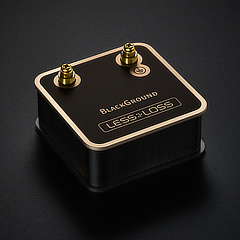

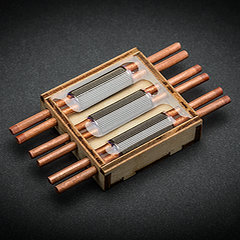
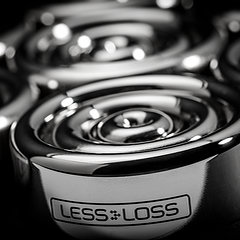
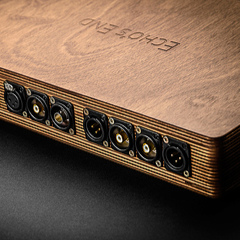
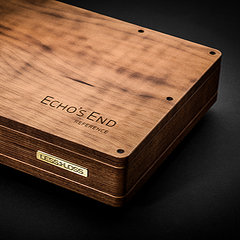
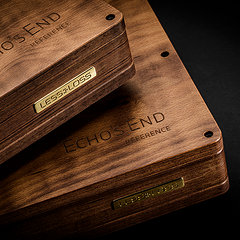


The Blackbody ambient field conditioner enhances audio playback quality by modifying the interaction of your gear’s circuitry with the ambient electromagnetic field. The Blackbody eliminates sonic smearing of high frequencies and lowers the noise floor, thus clarifying the stereo image.
Save ink and paper –
print from here!
Go to the Reviews Page
Write Review


Price: $1,323

    Number of units:   

Please e-mail Louis Motek
for large quantity orders.

2 units - 12% off  ($1164 each, you save $318)
3+ units - 15% off  ($1124 each, you save $597+)

Free UPS shipping!Free Worldwide express shipping.
Most deliver in 2-3 business days.


Although the Blackbody lowers the noise floor, is not a power filter. Rather, it complements your power filter by addressing your gear’s direct interaction with the ambient electromagnetic field. Where a power conditioning device leaves off, the Blackbody, as a field conditioning device, takes over. The Blackbody is not wired to your gear and contains no batteries or power supply of its own. Instead, within the device is a special reflector whose emission pattern approaches that of an ideal black body radiator. The unique aspect of black body radiation and its usefulness for audiophile applications is described below.
The Blackbody’s housing is made of a matte sand blasted alloy, while the recessed glass on both front and back sides ranges from pitch black to highly reflective upon changing the viewing angle. The frame with its rounded corners forms a square shape somewhat smaller than a compact disc in size. At 6.5 pounds (3 kg) it has a heavy and dense feel. The bottom surface which makes contact with your floor, furniture or gear, is perfectly smooth and clean and has no sharp spikes, abrasive felt or sticky rubber feet. Each Blackbody ships in its own protective case and includes a small instruction booklet.


If something is visible, it is radiating electromagnetic energy of a frequency which your eye is tuned to. If you turn off the lights, of course you won’t see anything. But even with the lights on, there are frequencies radiating off of an object which you never see. Look at any radio broadcasting antenna (your mobile phone will do) and you will see nothing peculiar. But take a ten minute walk, and your radio (or phone) can still “see” that station, even if it is now behind a large building. The station’s radiation is here among us even if we are oblivious to it, and it does not travel in straight lines.
When viewing one's self in a common mirror, the reflection one sees is actually already a second order reflection, the first being a reflection of the original light source from your own body. The colors you see are due to the selective absorption spectrum of yourself.
Likewise, there is an absorption spectrum for the material used as an equipment enclosure. The circuitry within the equipment radiates EM energy just as does the sun. It also is sensitive to reflections, just as are our eyes. The result is that all signals are sensitive to their surroundings. In the realm of electronics, these surroundings are called the electromagnetic field. The main difference between the mirror example above and the equipment example here, apart from the obvious difference of intensity, is that the frequencies involved are different. One speaks of a different bandwidth.
Shielding audio equipment from low frequency radiation using a mu-metal screen is effective due to its magnetic permeability. Low frequency hums are addressed well by this method. Other metallic enclosures are used to address higher frequencies. To be effective at the highest frequencies, enclosures must be air tight or soldered closed, or else we must employ special gaskets. These are not used in high end audio due to the many switches, connector sockets, display panels, and drawer slots for data discs which must be accessible to the user. Such electromagnetically tight gaskets are found along the shielded door seals of certified radio emissions testing laboratories. While thick aluminum blocks and other materials (carbon fibre composites, acrylic materials, artificial stone, hardwoods and epoxy-based composites) are increasingly common in the high end audio design world, their individual effect upon the sound quality is well documented by those who have experimented using the very same electronics within enclosures made of different materials.
There is an electromagnetic interaction of the radiation from the circuitry with the enclosure and other proximate objects which causes an audible coloration effect by superposition of multitudinous reflections of EM energy. These smear the timing and focus of delicate audio signals. It is exactly the influence of these reflections on sound quality which is addressed by the Blackbody ambient field conditioner.

Because each material has a unique electromagnetic fingerprint, called its absorption and emission spectrum, it becomes evident why so much emphasis is placed on enclosure build quality. In high end audio, all aspects of equipment design are found to influence the sound quality to some degree. The question is, which material is best, and what sound can it achieve?


This spectral influence is not limited to enclosure material. Your equipment rack, your scattered CD collection, and all other objects in the room affect the sound quality as well, and for the same reason. Everything, down to the very air surrounding your circuitry, is tied to the electromagnetic ecosystem of shared energy patterns. These interact at all frequencies. Each frequency reacts with different objects and patterns of objects in different ways. This depends on many factors, including the wavelength, phase, and angle of incidence of the oncoming radiation, as well as the macro, crystal, and molecular structure of the materials in question and resulting impedance of penetration. Two classic examples which take place at bandwidths we can see with the naked eye are the mirage in the desert and the interference patterns of oil films on water puddles.

Since these interactions are so interdependent and complex, audiophiles often introduce talismans, or tweaks, of mahogany, tourmaline, smoky quartz, and other such items placed in strategic locations throughout their systems. Typically, this specially balanced configuration in a highly tweaked out listening chamber takes years of trial and error to achieve. The attained joys of high class sound quality are of course highly desirable. Shouldn’t there be a more straight-forward and elegant way to address this stray noisiness?
To address this, what we need therefore is something with a reflection pattern which would contain no spectrum, and, hence, nothing to specifically color the operation of the circuit board. We are interested in frequencies which go well over and beyond the narrow bandwidth of audio signals. Audio circuitry deals with many frequencies, and through intermodulation, is sensitive to all bandwidths of noise. There is a type of reflector which does meet these high bandwidth requirements. It is called a black body radiator, and is sometimes used in infrared research.


When using a single Blackbody unit, the most effective placement will depend on the configuration of the circuitry within your gear (i.e. transformers, sensitive parts such as quartz oscillators, DAC chips, signal paths, etc.) and will require some trial-end-error before the perfect ratio between distance and angle of coverage is found. That said, in most practical situations this best ratio can be found between 15 and 40 cm from the circuitry at which it is aimed.
Placing the Blackbody too close will not harm your gear, but the resulting effect on the overall sound of the system will be better when the Blackbody is placed somewhat further back, so that more of the circuitry is affected by the black body reflection. From the front side of the Blackbody, the effective coverage angle is 35 degrees going outwards from the middle of the star pattern. The more proximate the Blackbody’s coverage area is to your gear’s circuitry, the more effective it will be: proximity and angle of coverage should coincide with as much circuitry as possible. A quick look inside your gear can help you get an idea of where the circuits are located. Several Blackbodies can be used in tandem to maximize both coverage area and effectiveness.


Go to the Reviews Page Write Review


New!

Copyright © 2012 LessLoss Audio Web shop / E-Commerce solutions by Web Solutions / Design & photography by Fonografika