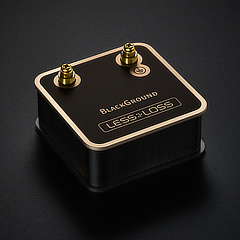
The Blackbody is unlike any other filter or conditioner. All power filters and conditioners address noise found on wires, but there’s another type of noise altogether. Until now, this inconspicuous type of noise has been largely unacknowledged. It is caused by constant electromagnetic interaction between gear and immediately surrounding objects: stands, racks, nearby signal wiring, enclosures, and other objects containing circuitry or not. This type of radiated noise is not confined to wires. The Blackbody works by changing the spectrum of these stray reflections, effectively solving the problem. Being the only conditioner of its kind, it offers a level of performance previously unattainable.
Initial impressions of the Blackbodies with DIY Blackgrounds reminds me of being at my favorite place to chill in the beautiful Maryland countryside which happens to be the gorgeous horse farm where I live. Imagine that it's a partly cloudy day, but as soon as the Sun emerges from behind a cloud, EVERYTHING POPS! You now feel more present and emotionally connected to your environment as a flood of color & detail washes over you. And that's a very good thing!
This review is for both the BlackGround and Blackbody v2. I'm not going to re-state what has already been said. What I will say, is that I have recently become addicted to LessLoss products. After reading forums discussing what these devices have done for others systems, I pulled the trigger and bought one Blackbody. I hooked it up as soon as I pulled it out of its UPS package. It provided a noticeable upgrade in SQ. Since then I've added one more BB and two Blackgrounds. I just received my second BG yesterday. The improvements in SQ have me glued to my seat and shaking my head. The music sounds so good with anything I play. I stream Qobuz through Roon and it's like every track has been remastered to some super high resolution method yet unknown to mankind. My system consists of ethernet coming off my Orbi router with a Furutech cable to a FMC converter to optical, then Melco ethernet cable to a Sonnet Hermes streamer to a Sonnet Pasithia DAC via Melco cable. From there I run Jena Labs Pathfinder cables to a Whammerdyne hybrid amp driving Lii Audio Platinum 10's with a pair of REL G2 subs. I feed everything with DIY Furutech PC's using their DSP 4.1 cable and NCF connectors. I use 10ga Duelund wire. Prior to having these 4 LL there were certain songs I could play at higher volumes because they are recorded so well they simply deserve it. I tend to pick out an artist and hit play on the artist Radio Station so I can enjoy some variety. When doing this, most songs I can leave the volume up, and certain songs I have to tun it down, because something sticks out with the mastering that just doesn't sound right. I know my system is pretty good, but definitely not the last word in being resolved. Fast forward to today, I have have been streaming different genres, time periods, and formats i.e. FLAC, for several hours and I have not needed to turn the volume down. Everything played sounds great. Along with my system explained above, I have done room treatments, grounding blocks, updated my power supplies, done carbon stickers, among many other tweaks, all have had some level of positive impact on SQ, but nothing comes close to what I am experiencing. These four LL devises have been a revelation. I just placed an order for a set of Firewall for speakers, and I will continue down this path. Thank you team LessLoss for your hard work and bringing us products that truly make a difference.
My history with the black bodies goes all the way back about 2011 when I happen to acquire a few.
Being the compulsive tweeker that I am I'm thinking they might be of help in what seems like an eternal struggle to get to a place where you stop thinking about the "sound" of a system and start enjoying the "music". Over the years I took them in and out not really taking them as seriously as I should have while I changed equipment and speakers tried new cables and vigorously attacked the power supply noise issue with many tweeks. I can't begin to say how much money I spent.
So recently I pulled the four black bodies (version 1) out of moth balls and made one final attempt to get them set-up and pointed in the correct direction. I sat back in my chair and after a while, to my amazement ,it finally dawned on me after a familiar piece was playing, that something had happened that made me take notice that i was hearing improvements to the music that were making me very happy.
Increases in detail without making things brighter sounding. A cohesion of the sound as if musicians were playing together better. An increase in musicality and a broad sense of greater harmonic structure flowing to the surface that had seemed to have been buried beneath layers of noise.Most importantly was a dramatic decrease in tension that always seemed to follow me no mater the source material. A sense of deep relaxation came over the presentation.. what a relief!
This whole episode led me to recently purchase two more of the new version two and they have only added to my greater pleasure. I'm so enthused about them I have made a commitment to completely re-cable my system with LessLoss products. (I'll have more to say about that in the future)
I always say.. "proof is in the ear of the beholder" and to my ears i have the proof that there is something going on in town..in building ...in the office of a company in Lithuania that's changed my perspective for the possibilities of achieving greater enjoyment of music. After all music is man's greatest attempt to reach out and experience the eternal love that surrounds and binds us together and in my opinion we seem to be closer than ever to that elusive goal thanks to the efforts of LessLoss.
When I first read about the LessLoss technology I was a bit skeptical. Since I already loved the way my system sounded I had difficulty believing that it could sound even better than it already did. Louis assured me that I would be impressed, so I took the dive. The first thing I tried was the C-MARC power cords with ENTROPIC treatment. The 2 power cords were applied to the DAC and to the pre-amp. At first the sound seemed to close in and become less involving. By the 3rd day of listening it became apparent that I was hearing sound that was more coherent, and phase correct, producing a more musical overall result. Inner details, textures, and the bass all took a significant step forward. After experiencing these effects I went ahead and added 2 untreated Reference level PCs to the amplifiers which resulted in magnifying the effects noted in the DAC and Pre-amp.
After the power cords I was curious about what the Blackbodies (total of 4) would do for the sound. This addition caused the most significant initial sonic degradation of anything I have ever added to the system. It took about a week before the benefits became fully apparent. Strangely enough the biggest improvement came after leaving the system off for a week. When I turned it back on the sound had totally transformed. It was as if a switch had been flipped bringing everything together. Suddenly there was a clear open window of sound with extended decays and sustains surrounded by the acoustic space specific to each individual venue and recording technique. All frequencies were proportional, gone was the bass heavy bottom up effect I had noted earlier during the initial break-in period. Also gone was the increased dynamic slam and exaggerated dynamic contrast that was previously prominent. What remained was a very natural balanced, and detailed presentation free from any detracting artifice. The background was much more quiet, allowing the tiniest details to emerge effortlessly, as if being spontaneously emitted from the space in between the speakers. The imaging was excellent before, but now it was if the speakers actually ceased to exist. The sound also became more concise, focused, and clean; making it apparent how much extraneous noise was infiltrating all aspects of sound before the Blackbodies were added. Initially this effect made me feel like I was missing certain aspects of the music, but over time it became apparent that it was only distortions that were missing, as new worlds of detail were exposed from old familiar recordings.
After all of this I could not believe that the sound could get any better, but Louis provided me with this quote from another customer. “How the heck could I even listen to it and rejoice in it back then?” This from a customer who thought it could not get any better. That was the exact feeling I had after installing the Firewall For Loudspeakers. In total I have added 4 sets to the speakers. I could have easily stopped after the the 1st set, as the improvement in tone, micro nuance, and overall integrity of the sound was beyond anything I could have expected. However after adding the 2nd set I too was saying to myself “How the heck could I even listen to it and rejoice in it back then?” The whole sonic landscape elevated particularly in the bass region which became even more effortless and detailed. It was as if the whole system was upgraded. The music was just “there” without any veils or resistance to most minute details. The sound was fuller from top to bottom, with more life like nuanced transients, and deep deep views into the sonic fabric and the most delicate textures and tonal inflections. The system never sounded this effortless, as if it had become super-conductive and friction free. Talk about lifting veils. Consequently I now have 4 sets of Firewall for Loudspeakers installed.
At his point I thought there is no way things could get any better, but as it turned out I was wrong, again. Louis built a custom set of Jumper cables specifically designed to work with Avantgarde Trios with BassHorns. These jumper cables were made of C-MARC, ENTROPIC cable with a DIY Firewall For Loudspeakers as junction splitter box. As usual there was an initial sonic suck-out upon first listen, but over the course of the week the sound again blossomed into something I have never before encountered from the system. Even after adding all of the other LessLoss devices, the sound again took another leap forward. It is not that I didn’t think the system sounded good before, it’s just that the improvements were of a type I had not yet experienced. All of the other improvements to the sound were still present, but were now being presented in a new light. The soundstage, imaging, and acoustic space all seemed come together to form an aural illusion so seductive and infatuating that I cannot stop listening and rejoicing in the sound. This type of sonic improvement is difficult to put into words, but after you hear it you will know exactly what I’m talking about.
Effortless, organic, liquid, holographic, 3D sound reproduction appears to be a byproduct of not just eliminating noise from all power and signal carrying cables, but of also reducing the effects of environmental EMI and RFI which can permeate every component. That is exactly the result I feel has been achieved from using the LessLoss devices. It is very difficult to say which device has had the biggest impact, but I can say that they appear to work synergistically. Individually each device has made sonic improvements which after hearing I did not want to live without.
My compliments to Louis and his organization. They have have proven to me that it is in fact possible to improve on even the most impressive sound systems, regardless of how good they already sound.
Associated Equipment:
The entire system has evolved over the last 17 years. The only components that still remain are the speakers and upgraded versions of Audiopax Model 88s which were upgraded to MkII status in 2009. Every component including the cabling, electrical conditioning, vibration control, and room treatments were all selected after careful auditioning and confirmation of their sonic synergy with the overall system. Consequently, each addition has advanced the sound in a desirable direction. Many components have come and gone to arrive at its current state.
Roon Nucleus: music server
Lumin U1: music streamer
AQVOX: CAT 7 ethernet cable on all internet connections.
AQVOX: Ethernet Switch (between Modem and Lumin)
Berkeley Alpha DAC Reference II with MQA
PS audio Signature BHK: Preamp
Audiopax Model 88 MK II: Monoblock Amplifiers
Avantgarde Trios with Basshorns: Speakers
Video: Oppo UDP-205: Universal DISC player
High Fidelity Cable Co: For all Power conditioning and line level, and speaker cables
LessLoss jumper cables
LessLoss Technologies: Power Cables to all components via HFC Professional Series power distributor
LessLoss Firewall For Loudspeakers (3 stereo pairs, one for each speaker driver and 1 integrated into jumper cable junction box)
Room treatments:
20 inch ACS stereo tube traps
Corner ceiling traps.
Grand Prix Monaco: Equipment Stands with Apex footers and ceramic ball bearings.
All stand legs filled with ferrous steel shot.
Support shelves upgraded to 3/4 inch glass.
All footers, shelf spacers, and tube dampers are from Herbie’s Audio Lab.
This is a review about my upgrade from 5 to 10 Blackbodies v.2 (“BB”).
Please check my previous review from August 16 about my first set of 5 BBs.
Of course, I had my doubts about this upgrade, but Louis knows me pretty well by now and offered ample insurance. And, yes, it is worth every penny. I received them almost 2 weeks ago and feel ready now to offer my descriptions.
BBs do need some time to come to full performance. This might partially be caused by the ground cables burning in, but most of it must be the full adaption of the EMF in the room, which seems to take quite some time (sorry, just a guess after playing with many former radiation tweaks). The first hour was not yet enjoyable, incoherent, no solid groundwork for the sounds, although generally bass was there. By the end of the day, a clear improvement was there, especially with the timbres of instruments and voices. Richer and fuller. But the 3-D space was quite flat, which changed strongly during day 2 and 3. And then a huge punch suddenly was available from my system. Lots more air moving. And even this morning, I was shocked how well it sounded compared to my last sessions.
Most of the last improvements were more stable stage objects. And yes, most sounds seem to become objects with bodies. Very palpable with “grounding”. It feels very natural and believable. Out of nothing, there is suddenly an entire human body and sings. Better close your eyes.
And for the first time, I can really claim that the loudspeakers and the entire system disappeared... again close the eyes, and crank it up. It doesn't happen at lower volumes. But as Louis described his sessions with the BB, you simply catch yourself at way higher volumes, just because everything sounds undistorted at these volume levels, which was not possible before. I can confirm this!!! And this factor lets you discover details that you would not at lower volumes. And about confirmation: I actually checked whether the purported orientation was just a hoax… (sorry, Louis) …but after a night of pointing the BBs into other directions than those specified, it all fell apart. Harsher voices, though rich, and very flat 3-D.
Back to the review… all these extra details come with no stress at all. Cannot find any disturbance of my body, just the opposite. Can hardly leave my sweet spot… totally addicted to what I hear and feel. And this was not nearly as much with “only” the first 5 BBs.
So, bottom line, more “oomph” and more meat on the bone, more believable and stress free, and addictive. And as budget allows, I will order more of these wonders. Btw: THC will not give you a cheap alternative, even if legal where you live :)
In my previous review of BBs, I mentioned another product which costs about double that of a set of 5 BBs. So now with 10 units I am at the same price, and I fully stand by my decision. This is so much more believable and natural. This other product's manufacturer claims not to put more radiation into the room, but they alter it in such a way that my body was aching. And with the BBs, I feel even better with more :)
So my final recommendation: get more, if you can!
And talking about addiction… My most played (daily) records that easily reveal all these differences:
Nine Horses (David Sylvian): “Snow Borne Sorrow” and “Money For All”. Not for everyone's taste, a mixture of Pop, Indie, Experimental, Ambient, and Jazz (mostly a little melancholic), with rich instrumentation from acoustic to electric and electronic, and the mesmerising voice of David Sylvian.
Only CD resolution, downloaded from Qobuz. CD is great with the LessLoss Echo's End DAC !!!
Thanks again to Louis and his team. This is an enormous jump!!!
After enjoying all my LessLoss products and seeing a consistent engaging natural sound in all, I was daring to get the early bird Blackbody v2, even though it seems strange or “esoteric”.
So, I have 5 Blackbodies with cabling since about 2 weeks.
And it really is another surprise, what Louis brings to the market here!
I could name all benefits as for all other LessLoss products that I wrote reviews on. But this has another perspective. So first the “standard” LessLoss benefits as from the other products:
A jaw dropping soundstage, especially into the background
More silence in the background … some call this blackness, so “Blackbody” it is!!!
Less graininess of sounds and voices, but at the sane time more details and micro dynamics
More natural timbres of instruments and especially from voices
Strong presence
More liquid flow
Many sounds, that I never heard before
Better deciphering of lyrics
But what does this mean for the listener? The obvious soundstage extension goes as far as wrapping you into the music scenery … Not all recordings but many. On according recordings, voices will stand free and close, with very natural believable human touch. The engagement goes as far as suddenly feeling almost like being in trance … Without drugs :) Plenty more of toe tapping and head bobbing for me!
So, highly recommended … And I am ordering more :)
Better is the Enemy of Good …
At the same time, as the early bird started, I just received a device, that I had ordered 2 months earlier. This device was aiming for some overlapping goals as the Blackbody by dealing with EMI and RFI issues. A very highly acclaimed brand from several shows, which I will not name here, in an according high price range. So I had a week of listening with it before the Blackbodies came in. It was also a jaw dropping experience and a fantastic soundstage. But when the Blackbodies were installed, voices and instruments sounded more natural, rich, and less grainy, and there was more ambient information, especially in the background. So I tried the Blackbodies without the other device and it was even better. Only after this other device was completely removed, I got unstressed and everything started to be consistent.
So even more congratulations to Louis and his team, to bypass this other super high tech solution with ease … And a lot of work.
I have today received a set of ten Blackbodies v.2. It dramatically elevates the sound with higher resolution, more punch and an improved soundstage.
Congratulations to yet another success!
Blackbody (1st version)
Briefly and to the point. Anyone who thinks his system has been optimized without adding the Blackbodies is missing the boat. They bring about an amazing and addictive improvement. Once sampled there\'s no going back.
Blackbody (1st version)
I purchased 4 units this summer after reading the great reviews. Initially I was skeptical that MY system could be improved by the field conditioner. I have been piecing together my system for over 20 years and tried all the tricks of the trade. I set these all near my components (my Zune, dac, pre-amp, power amp) and after putting on my favorite Chick Corea album I WAS BLOWN AWAY. I consider these a great bargain and worth it at twice the price. The sound-stage was improved dramatically, there was a certain lightness to the sound and the presence of the sounds I was hearing was unreal. The only issue I have with these is that I have to keep them away from my Orgone generators, also I noticed that my Himalayan salt power crystals weren\'t repelling as much bad energy, but that was easily fixed by moving them to another room.
Blackbody (1st version)
This is the 2nd product I have from LessLoss... the beautiful BLACKBODY.
I have been using 4 DFPC power cords for the past 3 months and can tell you: my system has improved a lot. So, I decided it\'s time for me to get the BLACKBODY.
I bought & received 1 unit of the BB about 3 weeks ago ---- I was so excited to hear what this black beauty can do. So, I placed it facing North by my transport. To my surprise, my system still improved (just when I thought that the 4 DFPCs were good enough).
With only 1 BB in place, I could hear more details, better sound staging & more natural sound with a very dark background.
After 2 nights of seriously listening (together with a few of my hi-fi members) WITH & WITHOUT the BB, we confirmed that this baby is A MUST HAVE for every audiophile system. The good thing is that the BB can be detected at once.
Bought another 5 BB units. Had them placed North, one for each component & one faced down on top of each speaker. (Please refer to pictures.)
Now, with all the 6 BB units in place, I can hear VERY CLEAN and FULL-BODY sound as the whole room is filled with music, the SLIGHTEST DETAIL, even DARKER BACKGROUND and the expression of the singer (the feeling - singing out from his/her mouth) & the musicians playing their instruments -- so damn real -- just too good to be true.
Trust your own ears. Get 1 Blackbody unit and try & you will be wanting more.
VERY HIGHLY RECOMMENDED.
Feeling very satisfied.
Update Dec 13, 2011:
Today I managed to get one more Blackbody faced down on top of my iso/power transformer. The sound still improved. Now I\'m using a total of 7 units.
Am very happy with the improvement of sound.
Blackbody (1st version)
What can these small little black boxes do to improve my system? After receiving these Blackbodies from my friend, I simply put them facing north, 35cm away from my Soul Note CDP as instructed. Playing a CD that I had played numerous times whenever trying out any new equipment or accessories. Immediately, I could hear a darker background, the vocal became more focussed and the harsh and edging sound of the violin that usually appears on this CD had somehow gone. Now, what I am listening to now is the true violin sound. In the next three hours I repeatedly played a few familiar tracks with and without the Blackbody, now I am sure I can\'t live without these small black boxes whenever listening to music. And I keep wondering what is inside this blackbody?
But who cares?! As long as it can bring back the life of the music, take me closer to the singer, then it\'s worth every single cent. The only question is: \"How Many More Blackbodies do I need?\" But I am sure that adding one or more Blackbodies will definitely bring my system to a new level. Bravo LessLoss!!!!
Blackbody (1st version)
The most effective audio accessory of the Year 2011. A must for every audiophile looking for real sound.
Blackbody (1st version)
Before I start writing my review I would like to thanks 2 people who turn the impossible into possible. (Now I have turned my music room into a concert hall.) Firstly, to Louis Motek who designs such powerful cables and Blackbodies. Secondly, to my hifi master Mr. Erick Ong who conviced me to try and experience these LessLoss products. Although I had enjoyed my system for the past wonderful 15 years, but having 2 LessLoss DFPC Signature cables and 1 Blackbody I\'m sure the real music journey is just beginning to take off. The Blackbody contributes the most! Wow... wow... wow... is it true? You can really see the movement of the singer, their expression, even the background musicians. It is so real that you feel like sitting in a musical hall enjoying your favorite singer perform live music for you. If I were to describe it in detail I may take a few days to do so.
Hats off to you, Louis Motek! Your products are making all those well known companies go to shame. I will be getting more Blackbodies from you and at the same time will introduce them to all real audiophiles that are looking for real music, not loss music.
Blackbody (1st version)
hen I first read about this product I was very skeptical. However being the happy owner of 4 DFPCs I decided to give it a try and buy one Blackbody.
I can definitely confirm that this little black box really makes a difference.
I placed it around on several positions in my system: the cd player, integrated amp, phono stage and I noticed the same effect: the soundstage acquires more depth and focus, instruments are better separated and ones gets a more being in-there feeling. Do not expect a change in timbre or extension. what I noticed was more transparency and a more palpable, involving sound.
The moment the Blackbody is removed from the system the idea that something is missing, a lack of realism and a more congested soundstage is apparent. This is no placebo as the effect is immediately perceived: Blackbody in position - Blackbody out... no need to switch on, switch off system, wait for components to warm up again. Therefore one can not be mistaken by his acoustic memory.
This product also is aesthetically pleasing and of high quality.
All I can say is that if you can afford it and you have a high resolution system, do not hesitate to buy at least one Blackbody.
Thanks
Blackbody (1st version)
I bought 3 blackbodies and now have a couple of weeks listening with or without and the improvement is quite astonishing. I use them in conjunction with ADAM active speakers, Ayre QB-9 and Octave HP500SE right now. What does it do? Well I already got used to it. Just how much the blackbodies weigh in the equation I experienced yesterday. I had an audio buddy at my house listened to music and drank an excellent red wine. He was deeply impressed with the sound. After a while he noticed those two boxes sitting on top of my speakers. \"What are those?\" he asked. \"Oh, that was a recommendation of this guy from Lithuania.\" \"Where you got your power cords from?\". \"Yes.\" \"Do they work equally well?\" \"Well they are different.\" Why dont we listen to the same song again without them?\"
So we did. \"Is this the same recording at the same volume?\" he asked. \"Uh, yes. I didnt change anything.\"
The difference was so clear, much clearer then I remembered. With the blackbodies we heard the finest details, much more room information, the color of the instruments was much more natural.
If we just listend to some hihat work, the difference was striking. Suddenly you heard not only what was hit, but where exactly the stick hits. Especially microdynamics improved in a way I havent heard before. It is kind of like with the powercords from lessloss. More natural but at the same time the sound opens up more. With the power cords, I got more weight in the sound, this you do not get from the blackbodies! In my system the blackbodies are definitely the icing on the cake. New dimensions in clarity!
We listened to two songs with and without and after that we decided to just listen to music and enjoy. Of course with the blackbodies in place!
Placement:
I first tried them with my Ayre QB-9. Well it is an improvement. but only marginally. Until i moved the blackbody about 15 cm away. I tried them with my active speakers, pointing towards the amplifiers. Not much effect. Then I placed them on top of the speakers. This is my favorite placement! I am still experimenting with the one unit, which is left. Right now, I alligned my gear in a way, that I can cover everything with the blackbodies \"beam\". Even my Audio Server (Computer) benefits!
Highly recommended! (I havent tried them with our radio in the kitchen ;-) )
Blackbody (1st version)
Regarding the star rating for the Blackbody, I don't know how to rate it with the star system as there is nothing to measure it against - except perhaps for perceived value for money - which is highly subjective. I trust the review will speak for itself.
Source : AMR CD-77 with 77.1 upgrade
Pre-Amp : Modwright 9.0 SE Signature
Amplifier : Nu Force 9.0 V2 SE monoblocs
Speakers : Salk Veracity HT3's
Cables : Solitone Model X interconnects with bi-wire run of Anti-Cable - double, twisted pair on mid/tweeter, single parallel pair on woofer
AC Cabling : Four Oyaide Tunami power cords terminated with Oyaide P004/C004 connectors. FIM 302 IEC's ( gold plated copper ) preferred on Nu Force.
Accessories : Hi Fi Tuning fuse ( Modwright ) Furutech fuses ( Nu Force ) NOS Mullard 5AR4 & RCA 5687's (Modwright ) Eichmann Toppers on Salks.
Powerline : Four dedicated 20 amp lines with four Oyaide R1 receptacles fitted with WPC-Z (aluminium/carbon fibre ) faceplates
Stand : Grand Prix Audio Monaco spiked to custom sandbox 840cm x 750cm x 140cm filled with 400-1000um high silica sand with 18mm hardwood formply used as spike interface. Formula One Kevlar composite shelf under source.
Powerline conditioning : Currently trialing Alan Mahers Quantum Studio, various Infinity CBF in/near power box, Infinity Shields on amp receptacles. 2 Enacoms permanently fitted.
Room : 18ft x 12.5ft x 8ft opening into kitchen and hallway at narrow listening end. Salk HT3's spiked to weight calibrated Equa Rack footers on suspended wooden floor. DIY cylindrical bass traps in room corners, set of Cathedral Sound panels front and rear at ceiling level, custom panel traps at first reflection points, wool carpet in front of speakers.
System Strengths : Dynamic, fast, detailed, transparent, large 3 dimensional soundstage - no subwoofer needed.
System Weaknesses : Slight glassiness present in upper midrange, may be due to mild high frequency tilt of Nu Force (measured stats) plus Modwright tends to a bright, solid state presentation.
History : 10 years of serious tweaking and auditioning of components/cabling/footers/racks. I have come to realise that the devil is in the details. Cabling, resonance control, AC power issues, room treatments, each have to be thoroughly attended to. This is no place for the faint hearted. Without such attention to detail, at best, hi-fi mediocrity is achieved.
Back in 1979 I had a beautiful analogue system ( the classic Linn Sondek/Grace/Supex/ Naim amplification/ Gale GS401A speaker combination ). After several years I onsold the system due to the rarity of decent recordings available in North Queensland (land of Oz) at the time. A brief flirtation with car audio culminated in a tri-amped Nakamichi split system. In 2000 the home audiophile bug bit again and this time it was the CD challenge. I still own four CD players with the Meridian 508 (a classic) currently outclassed by the valved AMR CD-77. As a member of the South East Queensland Audio Club, I have heard many different types of systems including several in the $100,000 + range, so I am familiar with good, different and indifferent sound.
The LessLoss purchase experience :
Louis Motek was a pleasure to deal with and it seemed the same professionalism and attention to detail was evident when organising shipment and even packaging ( clearly a perfectionist ) as went into the design of his Blackbody. The unit arrived within days of being posted, fortified with tight-fitting high density black (of course) foam in a black box, superimposed with the Blackbody design on the outside, to mirror the Blackbody on the inside. I believe this was designed so one can test the unit first without removing it from the sealed box, a pre-condition if the item is returned.
THE BLACKBODY STORY
My first knowledge about Lessloss audio products came a few years ago when I first read about their power cords on Audiogon. Out of audiophile curiosity, I tuned into their website and was attracted to the level of investigatory detail Louis Motek displayed in the technological ( and yet to be realised ) pursuit of his Blackbody, as well as his established product line. The Blackbody was then previewed in an esoteric sense as Louis had an obvious predisposition to explore theoretical physics and apply it to audio. I approached this with interest but a healthy degree of scepticism - how could one prove or disprove any of this. It was his obvious passion and sincerity that continued to maintain my curiosity and interest. When the Blackbody materialised a few years later, I was going to wait for the professional reviews to roll in before committing to an audition. However the pre-order special roped me in and I thought I'd give it a go, carefully going over with Louis the requirement for returning the Blackbody for a maximal refund, which I secretly expected. After all, this was not a power cord but an intangible black box - a completely passive device located some distance away from the componentry. I suspected it did something but exactly what. I have to this day rejected many well reviewed audio tweaks and accessories as neutrality was more often than not compromised to an unacceptable degree, even though performance in some areas was as claimed.
My system is fairly well tweaked and highly transparent. It walks a very fine line and the slightest change can upset the musical equilibrium with hi-fi heaven quickly descending into musical hi-fi hell. I first located the Blackbody under the Nu Force amps, on top of my sandbox ( I preferred the sandbox to the premium GPA Apex footer upgrade ). I figured if the Blackbody was going to clear up electronic garbage, then the switch mode power supplies of the Nu Force amps was a good place to start. In this location, the presentation changed, but for the worse. A sort of sonic smearing took place, rather than enhancement of any kind. To be fair, the Blackbody was located about 15cm from the amps - a little too close to give the proper 30 degree coverage to both amps. Next I tried it behind the Modwright pre-amp, sitting on the Monaco shelf. Again, only 15 cm from the back of the component on the edge of the shelf. Again the presentation changed, this time more favourably than with the Nu Force. There was some improved ambience and detail but with a trade-off. A shift in the frequency balance towards the highs exacerbated an existing system weakness.
On reflection at this point, I realised that anything that I had ever put on the Monaco stand other than the component ( I had tried many different component footers that had worked with my previous Spider Rack and custom granite shelving ) had upset the balance of this finely tuned stand. Even sandbags on top of the sandbox were detrimental to the overall balance while fine-tuning, creating frequency shifts that were clearly audible. So the Blackbody in these locations was imparting a resonant signature of its own by virtue of its mass - which was interfering with its intended passive function.
Next I tried a Blackbody facing down on top of the left Salk speaker. Again, a noticeable change with some apparent enhancement of the sound coming from the left speaker - but difficult to say whether this was better overall as it was no longer quite matched to the right. Trying it the other way around yielded the same result. I drew the conclusion that the only way to really tell here was to have a pair of Blackbody's. This would also reveal if the mass of the Blackbody was changing the resonant signature of the speaker enclosure or influencing the performance of the weight calibrated Equa Rack footers ( the Salks weigh 56kg each ). However, it was apparent the Blackbody was doing something positive here and I would have liked to have an extra Blackbody on hand to determine if the sonic result represented value for money.
Finally, I located the Blackbody on a CD rack fixed to the wall about 25cm behind the AMR CD-77. By this time I had begun to think it was not going to work in my system. Sitting back in my listening chair, it was as if a switch had been suddenly flicked. There was an immediate, unmistakable improvement in the sonics - an expansion of the soundstage accompanied by improved clarity and detail. On careful listening, the frequency balance was unchanged - the expansion of the soundstage was real and had occurred on its own merits, not due to a tipping of frequencies but an extension in both directions. I immediately removed the Blackbody to confirm this - the difference was black and white. The improvement in clarity and detail was consistent throughout the frequency range and bass fundamentals were more present. The only way I could think to explain this was that some sort of layer of ' grunge ' had been removed that had been previously hidden. Vocal nuances were enhanced and a relative subliminal aspect to the music emerged that made the music sound more like music. There was a realisation that there was no going back. This was not a subtle change but a significant one and rare in its total neutrality. The Blackbody was clearly acting as some sort of grunge filter, as surprisingly, that's exactly what you comparitively hear with it removed.
On the question of value for money, this would depend on the heights your system has scaled and which you aspire to. Unless there is some other way of getting rid of the sonic garbage, I now consider it indispensable. Louis tells me this is just the tip of the iceberg and that three located around the source give profound results. My stand doesn't lend itself to this but I am now considering the practicality of suspending a couple from the ceiling, just to satisfy my audiophile curiosity. However, I can say that just one properly located Blackbody is a worthwhile upgrade, without the presence of any downside. I can't say if this has expanded the known boundaries of audio by removing a hitherto unknown contaminant and that it cannot be duplicated by other means - that would have to be determined by those with more resolved and highly tweaked systems than mine.
Blackbody (1st version)
The Blackbodys are extremely good. I\'ve now got the best sound I\'ve ever heard. Listening has become a pure pleasure and joy, and I insist on setting up with the Blackbodys at all future audio shows featuring the Kaweros.
Rainer Weber
Technical Director
Kaiser Acoustics, Germany
Blackbody (1st version)
I\'m fully satisfied with the Blackbodys. I\'ve kept most them in their boxes because they\'re easy to place and I don\'t worry about them getting damaged.
One interesting point I discovered was that I could remove the vibration feet I had under my sources that made it more difficult to cover everything with the Blackbodys and I noticed that I didn\'t miss them at all.
The Blackbodys are also great for movies with a lot of sound effects, adding more realism. The only downside is you never know when enough is enough.
Blackbody (1st version)
Congratulations! I didn\'t want to believe in the Blackbodys but they do work.
The sound becomes more clear/clean, more profound and tridimensional. I now can very easily pinpoint the places where the voices and instruments are placed, even in depth.
I have a couple of Blackbodys around my source and pre and another near my conditioner (which made a huge difference). This combination really works.
I wish I had some more right now to put on my amplifiers and perhaps my speakers.
Keep up the good work.
Pedro Nunes
Portugal
Blackbody (1st version)
New Adventures in Sound!
A few days ago I received the Blackbody, so I had some time of experience, and I had two additional critical ears from the apartment below. It is impressive to hold the Blackbody in your hands and notice the impressive weight of the device. You have seen the pictures, but it is different to see and feel the Blackbody in reality.
My rack made it possible to place the Blackbody on the left and right side of each platform, so I could try it on every piece of gear, except the bunch of cables behind and I haven\'t tried it on speakers yet.
I will not bore you with details what records or CDs we listened to, or what part of aspects of the sound improved here or there, as you probably read a thousand times in the usual suspect magazines.
Let me only approve this:
The Blackbody functions as stated by LessLoss.
Every piece of gear I tried it on benfits in nearly the same strength.
It even works on the turntable, and that was something I didn\'t expect.
The critical second pair of ears and I detected the biggest improvement with a not ideal placement. Directly on top of the poweramp, facing towards the transformer below.
Records and CDs that I thought sound nearly perfect get shockingly better with the Blackbody.
You may have tried the whole range of tweaks available, but the Blackbody adds a new astonishing quality of improvement. Only one Blackbody shifts the sound to a new level of realism. It is not a subtle change or possible hallucination. In the studio with the musicians? You are there.
Equal improvement in sound quality could be had only with expensive investments. You can live happily with the sound that you get with your existing gear by adding only one Blackbody for a long time. So at first sight the Blackbody doesn\'t seem cheap, but the price is definitely modest, when you realize what it is cappable of and that you get something totally unique, never available before. Bear in mind that worldwide shipping with UPS is included. In Europe the exchange rate from USD to EUR adds another benefit.
This is no voodoo mambo-jambo, just impressive science in physics and surely a lot-lot-lot of brainwork. Are there any other companies telling you in such extreme detail how their products function and the theoretical foundations? Well, until now I haven\'t read anything similar.
How can you go wrong? Try one without unpacking it and if you are not satisfied you can give it back. But be prepared that you won\'t go back to listening without the Blackbody.
Absolutely wonderful product... and way cool it looks, too.
Blackbody (1st version)
My highest congratulation for the design and development of the Blackbody.
Even directly being used straight out of the box the Blackbody\'s effect was immediately present.
I put one Blackbody behind my TacT Millenium digital amp and the other two Blackbodys at the external crossover boards of my loudspeakers - and I think I should have ordered a six-pack in order to \'clean\' the source components including the DAC 2004 and my power conditioner without loosing the already achieved improvement.
In one word: transparency in its holistic meaning is what the Blackbodys are \'producing\'. Transparency means that the often used phrase of removing a curtain is now truly valid. Fine details never heard before. The harshness of CDs has vanished and even distortions have disappeared. In consequence, staging and depth perception are incredible.
A real jaw dropping experience.
The effect is not subtle at all and much bigger than the effects achieved by power conditioning and high quality power cables.
The low resolution CD formatted music now really has an analogue touch.
I wonder how the effects will be on a phono preamp and turntable pick-up.
Success for your plans and activities.
Michael, Germany
Blackbody (1st version)
I am a big fan of LessLoss products having improved my system with the Signature power cords, the Firewall, and slaving a CEC 51xr transport to the DAC 2004 Mkll. I purchased 6 Blackbody units and placed them on top of the Wilson Watt/puppy speakers, and next to the Jeff Rowland model 6 mono-amps, the CEC 51xr and the DAC 2004 Mkll. The effect was beyond my expectations! The sound became softer and much clearer. The definition of the sound improved in all aspects from the bass to the treble. The music is as close to a \"natural\" sound as I\'ve ever heard. The electronic edge disappeared and the music became alive and oh so enjoyable to listen to. I am now able to enjoy CDs that before were harsh. I am more than satisfied with the performance of the Blackbody units. Thank you Louis!
Blackbody (1st version)
Actually, this is more of a small add-on to my personal experiences with \"light\" frequency in the effect of sound reproduction. I do not profess to be a scientist on this front but have trusted my ears to let me comment.
I read the Blackbody article with great interest. An actively powered blue light bulb was mentioned as enhancing sonic quality.
You may want to explore \"reflected\" light -- that is, something passive. I have found ORANGE PAPER (unwaxed) sticker dots (the ones you find at stationery stores to color code documents, folder, files, etc.) to be extrememly effective in enhancing sound quality. Other colors just did not cut it, the worse being blue and green. I have found dual use for this...interplay of reflected light and resonance (specifically, sympathetic resonance...why fight resonance when you can never get rid of it, and you do need it afterall), all on the passive \"unpowered\" front.
The people at Shun Mook have known about this for a very long time.
Try it, you may be just as surprised and perplexed!
Cheers,
Kenny
Until recently, the audiophile community has underestimated the relevance of near field electromagnetic (EM) interaction to audio reproduction quality, specifically to the coloration of sound. While audiophiles generally agree that objects like racks, stands, and equipment feet influence sound quality, it is also widely believed that this influence is only vibrational (mechanical) in nature. According to our own research, a significant source of that coloration is actually not physical in nature, and is due instead to near field EM interaction. After we explain what kind of tests we carried out which led to this conclusion, we’ll go on to postulate that indeed any object in the vicinity of your gear’s circuitry influences the resulting sound quality to some degree, even without making physical contact with it. We’ll then segue into the basics of electromagnetic radiation and how this relates to high end audio. By that point, the problem of EM interaction will be obvious and we’ll then explain what makes the Blackbody a uniquely effective and elegant solution—one that offers audiophiles a new level of accuracy in audio reproduction.
Nearby objects and sound coloration: what’s the connection?
How can it be that physical objects, just by being in proximity to your gear’s circuitry, influence audio reproduction? How can the mere presence of a component’s lid, equipment feet, or rack and the like, audibly color the sound—especially if the circuitry is not directly involved?
The standard audiophile answer:
To find the link between your circuitry and nearby objects causing sound coloration, an obvious place to start looking would be the influence of speaker vibration. First, through airborne sonic vibration (sound pressure levels in the air produced by moving speaker cones cause nearby objects to resonate like a microphone), as well as structurally coupled vibration through the floor (when your speakers play, their movement also transmits vibrations directly through the walls of the speaker cabinet, through the floor, into your rack, and from there to your components and their circuitry). In both cases, your gear is influenced by speaker vibration that permeates sensitive operating circuitry, creating unwanted microphonic signals there. These parasitic signals are then amplified and degrade the resulting sound quality in an acoustical way from speaker to electronics and back again through the speaker. A simple light tap on any tube of a tube amp will instantly show this.
Naturally, then, we do all we can to deal with these physical vibrations, hopefully without at the same time introducing objects that degrade audio fidelity in some other way.
Myriad solutions now exist to influence acoustic interaction. The embarrassing thing is, when listening through headphones, they’re just as effective. This makes one wonder: is it really just acoustic interaction?
Something we audiophiles have been missing:
While LessLoss acknowledges the role acoustic interaction plays in sound coloration, we also know that this cannot be the entire story. The idea that all of this is due to acoustical microvibration alone is false, because, when the equipment is acoustically isolated, the problem still persists. The headphones test proves it. Using headphones instead of loudspeakers brings the equipment and any vibrating surrounding objects into complete acoustic isolation from one another. (If there’s a buzzing transformer in your gear, then this becomes a more complicated story of course). Testing under these isolated conditions makes it obvious that while manipulating the objects around the circuitry, and without even any contact between the circuitry and the objects, the varying coloration in sound persists. This can only be due to something inherent in the physical surrounding objects’ proximity to the gear. To understand how this works requires a short discourse on the topic of electromagnetic radiation.
EM radiation: the basis for this interaction
EM radiation is energy with electrical and magnetic properties that travels in waves. These waves are produced by moving charged particles. Since all things are made up of charged particles, every object radiates EM energy (unless at absolute-zero temperature). Matter also selectively absorbs and reflects EM energy, and each material’s EM absorption and reflection pattern is distinct. All matter has its own fingerprint, a type of pattern called a spectral signature of radiation. These patterns are so distinct, scientists can identify the elements of nature from these unique spectral radiation patterns alone. Even the atmospheric composition of distant planets reveal themselves in this way.
The mirror's own absorption spectrum is at frequencies which we can't see. Everything else, including what we can see, is reflected. When we look at ourselves in the mirror, the color we see in the mirror turns out for our eyes to be the color which our own body has not absorbed. Another name for this is the absorption and re-emission of EM energy.
Taken in perspective, we live in a world full of complex EM interaction. Objects absorb and reflect EM energy twenty-four hours a day, and the vast majority of it we don’t even see. The things we can see, we see only because the objects in question reflect EM energy at frequencies our eyes happen to be tuned to. Even more peculiar is that EM waves don’t always travel in straight lines. Your cell phone, for example, can still communicate with a cell tower, despite the large building standing between your cell phone and the tower.
In our world, where EM radiation permeates the physical domain, objects constantly interact in ways we’re often completely oblivious to.
So what does EM radiation have to do with hi-fi?
Quite simply, different materials proximate to your circuitry will affect that circuitry. Your component enclosures, equipment rack, scattered CD collection, and all other objects in the room—including the chemical composition of the air surrounding your circuitry—are active participants in the shared EM ecosystem. In this mutual network of interaction, the EM radiation emanating from your gear interacts with all other objects’ absorption and reflection patterns in a complex fashion, much like the complex echo and diffusion of sound waves from various objects in a church, only much more quickly, to the point of occurring practically instantaneously.
Electromagnetic energy interacts differently with each material which is proximate to the radiating circuitry. Absorption and reflection patterns result as a function of the unique qualities of these materials.
initial radiation of EM energyre-emission (reflection) of EM energy
Since objects always selectively absorb and reflect EM radiation, leaving their own spectral signature in the reflection, they affect your component even if its circuitry doesn't directly "see" these colored reflections. The coloration we speak of is low level: it does not cause grave distortions such as data-fallout errors (although this can occur with the introduction of too much near-field UV light, for example). But its presence is palpable even with nearby objects which electromagnetically interact with the gear in only a passive way by means of their own distinct reflection pattern. The easiest way to convince yourself of this is to take your entire CD collection and place it all around your system, as close to your electronics as possible. Have a listen. Then remove them as far away as you can. Listen again. When they are moved away, the sound substantially clears up due to the absence of multitudinous and haphazard EM reflections from the metallized discs which were placed all around your gear.
Matter in proximity to audio gear smears the timing and focus of delicate audio signals, raises the perceived noise floor, and adds a distinct coloration which manifests itself as a sort of sonic sameness which simply doesn’t go away from recording to recording.
Different enclosure materials result in different sound coloration
This explains what the audiophile community has for the longest time found very puzzling: circuitry enclosures of equal design, but made of different materials, somehow manage to cause undeniable differences in playback quality. Much emphasis is placed on build quality in high-end audio because all aspects of equipment design influence sound quality. Now, armed with our working theory, we can see that this difference in sound is due to EM interactions between signals and enclosure materials with different spectral signatures. We now have a good explanation for why we have felt the need to introduce talismans, or tweaks of mahogany, tourmaline, smoky quartz, and other such items placed in strategic locations throughout our systems. Typically, this specially balanced configuration in a highly tweaked out listening room takes years of trial and error to achieve. No wonder: there are so many complex EM interactions to account for.
Faced with a clear problem that manifests in such complexity, shouldn’t there be a more elegant, more accurate way to control this ambient EM labyrinth of interaction?
Our solutionThe Blackbody
Now that we have a clear description of the problem, it is not difficult to say what the ideal solution should do. It should prevent EM reflections from interacting with component circuitry signals, just as in our previous example the use of headphones prevented acoustic interaction. This is precisely what the LessLoss Blackbody does. It is modeled after the perfect blackbody—a hypothetical object from physics. A perfect blackbody would be an object that perfectly absorbs any EM frequency.
Black body radiation is a special case of thermal radiation, in which the spectral radiance of electromagnetic energy depends only on temperature. Thus, at room temperature, black body radiation portrays no discernible spectrum.
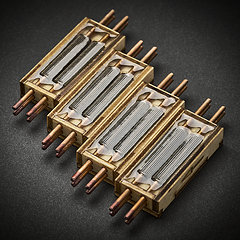
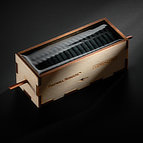
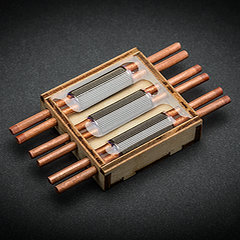
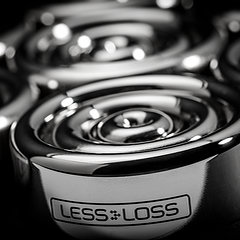
You can see how the blackbody got its name: by absorbing any EM wavelength, and by radiating none in our visible bandwidth, the device is as black as black can be; you might even say it is blacker than black, since it’d be the absence of light radiation altogether. Our version of the blackbody contains no power source or circuitry of its own; instead, the device itself is a specially formed array of concentric reflectors whose emission pattern in total approaches that of the ideal blackbody radiator. By creating this near perfect blackbody, we’ve created a device that, simply by being placed in your gear’s proximity, will absorb a substantial portion of radiation at that location. There, gear will no longer be able to bounce EM radiation off proximate objects, only to have it return to influence its delicate signals and degrade sound quality. The Blackbody’s EM radiation pattern lacks a distinct spectral signature.
The special thing about the Blackbody is that no matter what wavelengths you throw at it, the reflection will always be largely the same. This type of brkness is highly desirable in the proximity of sensitive audio signals, where the most minute coloration is appreciable. Considering the large bandwidth thus influenced, the electromagnetic background noise as a whole is effectively reduced. This purifies the resulting audio.
This is not your typical "talisman" tweak. Such tweaks are accompanied by diminishing returns once coloration sets in. The Blackbody, on the other hand, is the only object that removes the influence of near-field EM reflections. Unlike other tweaks, it lowers the system’s noise floor, yet at the same time does nothing to introduce its own color the sound.
Positioning the UnitFor top perfomance
Grounding the Blackbody
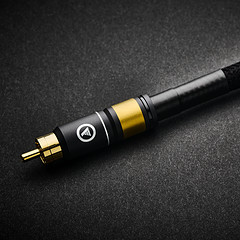
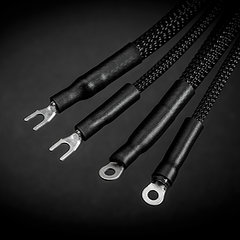
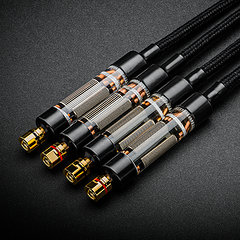
The Blackbody comes with a grounding option. See image below.
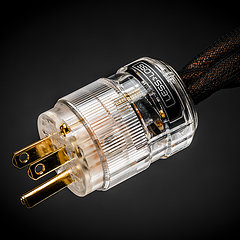
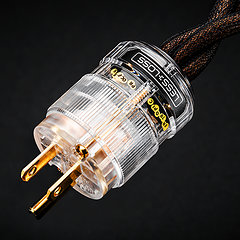
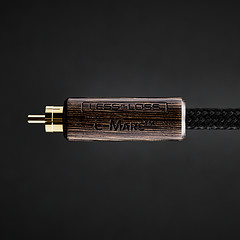
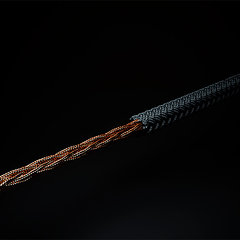
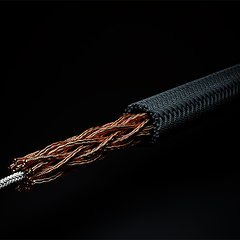
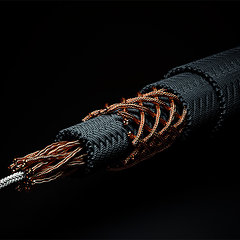
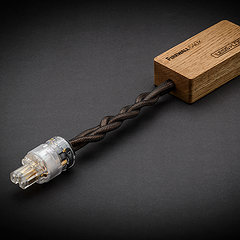
On the side of each unit is a small mounting screw [1]. LessLoss makes custom length grounding cables out of C-MARC™ wire [3]. These are terminated on one end to an M3 size silver plated ring terminal [2] and to the other with a high quality wall plug [4]. The grounding wire is connected only to the ground pin of the wall plug [4]. The other two power pins of the wall plug are not connected electrically. In this way, one can easily ground the Blackbody using any available grounded wall outlet [5].
The ground wire is very lightweight and extremely flexible, making its installation very easy under any circumstances. The Blackbody grounding cable comes in two sizes (Large and Small) and in various lengths.
Grounding multiple Blackbodies
A ground wire option with ring terminals [2] at both ends is available in order to chain two Blackbodies together.
In this way, only one ground wire with wall plug ending [3] is necessary and only one wall socket [5] is thus used.
Additional Blackbodies can be chained together using additional ground wires with ring terminals at both ends.
Some pointers on installation
One uses the tool above (pressing the "SHOW ME HOW" button) to determine the angle of the stand needed at any specific place on earth. It is very easy to use.
How many Blackbodies v.2 should be used in a given system?
Please note that it is far more important exactly how you set up the Blackbodies, rather than exactly where you set them up.
The advised "mathematics" of getting one unit for each specific piece of gear is only a general rule meant to exemplify that the larger and more complicated the system, the more Blackbodies should be used in order to get more profound results. So once you have these on location, there is nothing to keep you from trying different combinations or numbers of them near each of your specific components.
The most important thing to consider is the placement direction and the stand angle. In the northern hemisphere they should point towards the North. Of subordinate importance is the actual physical location of these units regarding their height and distance from the gear. Imagine viewing your system from an airplane. There will be far greater influence if the Blackbodies are facing the airplane rather than whether they are a half meter here or there. The whole house is just a speck on the radar, but the direction from plane to house is very exact, and in fact, the further the plane is from the house, the more exact the direction has to be. So in this way, consider the placement of the units throughout the system in a visually aesthetic way rather than considering some crucial distance. Remember: direction and angle are paramount. And grounding them is also audibly beneficial, though not entirely necessary.
Don't consider the Blackbody "assigned to a specific piece of equipment"
These are beneficial for the whole system. Think of a Christmas tree with ornaments on it. You don't put on a single ornament by counting the branches, or counting exactly how many ornaments you have on each branch. On the contrary, you look at the whole picture and try to spread out the ornaments in a visually appealing way, so that the result is a decorated tree as a whole. In the same way, think about spreading out the Blackbodies over the whole system. If you have more units, it will only get better. Even if your system is made up of only a single DAC/Amp combo and two speakers, if you have 5 Blackbodies there, and then you add 5 more, the results will certainly get even better! There is no doubt about it. So the general rule to be considered is that the more spread out a system is over the space of a listening room, the more Blackbodies are recommended in order to provide maximum effect. Hence the recommendation of starting with 1 Blackbody per component of the entire system. It is recommended to count speakers as 2 components and to also include power distributors in this calculation.









 initial radiation of EM energy
 re-emission (reflection) of EM energy


