
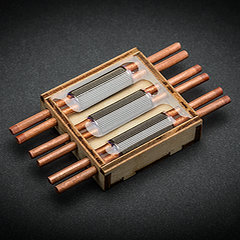
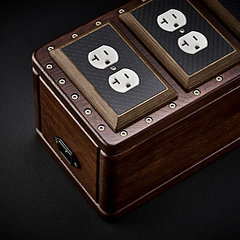
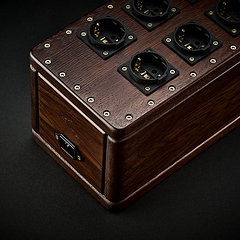
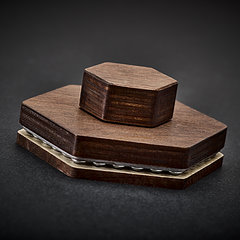



Technical Answers about the LessLoss BlackbodyWhat is the difference between electromagnetic radiation and black body radiation?Electromagnetic radiation is the oscillation of a continuous electromagnetic field. Some aspects are explained in a wave model while others are explained in a particle model. Black body radiation is a special case of thermal radiation, in which the spectral radiance of electromagnetic energy is a probability distribution depending only on temperature. Because light is the oscillation of a continuous electromagnetic field, the study of black body radiation reveals how continuous fields can have a temperature, something which contradicts the expectations of physics prior to 1900 (a.k.a. "classical physics"). Why does black body radiation exist?Until 1900, classical physics could not solve the problem of the strange spectrum of radiation emitted by a hot oven. The false prediction at the time was that an oven should radiate an infinite amount of energy, a problem which was known as the ultraviolet catastrophe. Max Planck solved this dilemma by introducing the concept of associating each wavelength with a specific amount of energy. By introducing math which quantizes energy in the form of indivisible packets, the observed blackbody radiation coming from ovens was then predicted accurately and a new physics was born: it was called "quantum," meaning discrete in nature. So what does this have to do with high end audio?For audiophiles, one major underlying principle of energy interaction which influences sound quality is the absorption and emission spectra of proximate material. All materials exhibit unique fingerprint emission spectra when exposed to electromagnetic radiation. For example, in this way, satellite technologies, hundreds of kilometers from the Earth, can be used to accurately differentiate fields of alfalfa from cannabis as well as bedrock of granite from that of quartz, even underneath the earth's surface. This is done by analyzing the spectrum of reflected electromagnetic radiation from the material in question. Another term for this is the emission spectrum. It is an innate property of matter that all materials exhibit a specific emission spectrum when exposed to EM radiation. This is why we see different colors. The difference for spectrum analysis is that, where our eyes see only the surface radiation, there are other bandwidths which we cannot see but which are just as present and interacting. All EM radiation, visible to us or not, partakes in the energy transfer between objects.
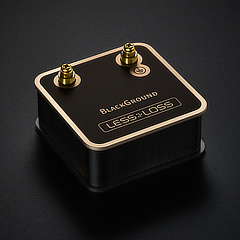
In the above drawing, electromagnetic energy radiates from the gear’s electronics. The EM reflection returning to the gear is modified by the static absorption / emissivity spectrum of proximate material, slightly modifying its original spectrum. This is the fundamental reason why audiophiles report hearing the effects of repositioning proximate objects around their sensitive audio systems. In this sense, one can say that color does affect sound, but to be accurate, this statement’s scope must be expanded: all electromagnetic interaction affects the sound quality produced by hi-fi gear. So what is novel about the LessLoss Blackbody?The LessLoss Blackbody addresses this issue in a novel way. Black body radiation at room temperature has no significant spectrum, so the reflection the gear sees is not similar to the original in any way except for the amount of energy. The proximate Blackbody device provides an absorption / emissivity spectrum which, in contrast to other materials, is not static in nature. Rather, its absorption / emissivity spectrum can be said to change along with the signal. In other words, anything goes in; and always only the same black body radiation comes out.
In the above picture, we see the Blackbody’s principle of operation. Electromagnetic energy radiating from the gear is composed of a rapidly changing highly prized spectrum. The spectrum changes in real time along with the signal being played back. The slightest coloration of this sensitive signal is audible. When the Blackbody is placed next to the gear, the EM reflection the gear sees is modified to become a transformed form of the original spectrum of energy. The transformation process undergone in real time changes the spectrum of energy radiated from the gear into that of a spectrumless room-temperature radiation pattern known as black body radiation, whose total energy is the same as that of the original. So how is this better than, say, my favorite mahogany, tourmaline, smoky quartz, or other electromagnetically influential talisman?The absorption / emissivity spectrum of all materials must be considered in terms of a closed system, and because of the first law of thermodynamics, they must add up to zero (with the exception of some loss to heat). There is therefore nothing mystical about the fact that the energy spectrum transferred between a high end audio device and a proximate object will always be related. This holds true for the LessLoss Blackbody as well. In sharp contrast, the novel aspect here is that, for the first time, the audiophile is presented with the possibility of having a related energy exchange without a related spectrum exchange. This means that the resulting sound of the audio remains uncolored, because the informational content of the reflection is in no way related to that of the emission originally brought forth by the audio gear playing the desired data on the recording.
Remember that in electronics there is no emission without supplementary induction. The two go together, and take part in the same continuous electromagnetic field. But if we can divorce the emission from the inevitable induction in terms of spectral quality, we have made true fundamental progress instead of having, as is customary, colored the audio this way or that through a filtering of the reflected EM energy via choice proximate materials and their individual static spectra. Ok, then. Name the principle of operation in one sentence. What is the core idea?In summary, because the energy association between two electromagnetically interacting proximate objects must always, through nature's design, be related, it is the object of the LessLoss Blackbody to divorce completely the spectral aspect from this mandatory interaction to provide an elegant solution to the problem of spectral interaction of proximate materials and their associated coloration of the resulting sound quality in high fidelity sound systems. Can you compare this with something largely known from the traditional world of electronics?A crude analogy can be made between gear being used with a proximate LessLoss Blackbody and a tuned digital line in terms of energy transfer and reflection avoidance through impedance matching. When a 75 Ohm digital line is terminated in a 75 Ohm resistor, the 75 Ohm output of the transmitter does not see the end of the line, and theoretically, no reflections are added to the signal propagated down the line. Similarly, a piece of gear broadcasting its loss signal, upon receiving reflection from the Blackbody, "sees" nothing there. The reflection bears no similarity, although the energy is indeed present in the form of black body radiation. Because the reflection bears no similarity, it has no effect on the signal, which is a prized and specific spectrum of EM radiation in contrast to spectrumless black body radiation. Another analogy may be drawn to the fine art of noise shaping in digital filtering algorithms. If we must live with a certain energy of distortion, it is an art to shape that energy into a form which least influences our appreciation of the delicate sound signal we are interested in preserving. Similarly, because of our gear's necessity of being proximate to other material which will inevitably influence the sound of the audio in subtle yet (to audiophiles) significant ways, we cannot eradicate this interaction, but we can transform it into black body radiation in order that it bear no more similarity to the original audio signal spectrum, and, hence, will not color the sound. Read on about the long road to the development of the LessLoss Blackbody. |
|
Copyright © 2010 LessLoss Audio Devices Store / GLOBALTUS e-commerce solutions / Design & photography by Fonografika
|


