






What makes an audiophile power cord different?
An audiophile power cord differs from an ordinary one in how the wire inside it is built: it is designed to reject electrical noise, not merely to carry current safely.
Any standard power cord will deliver power. That is not the hard part. The hard part is that the same wire carrying your current also behaves as an antenna, and whatever it picks up travels into whatever is plugged in at the end of it.
An ordinary cord does nothing about this. It was never asked to.
What is C-MARC wire?
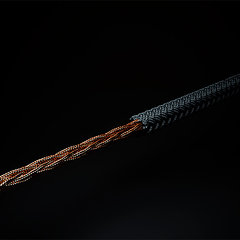
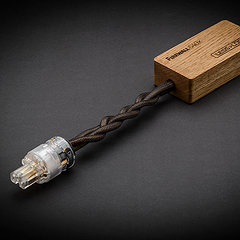
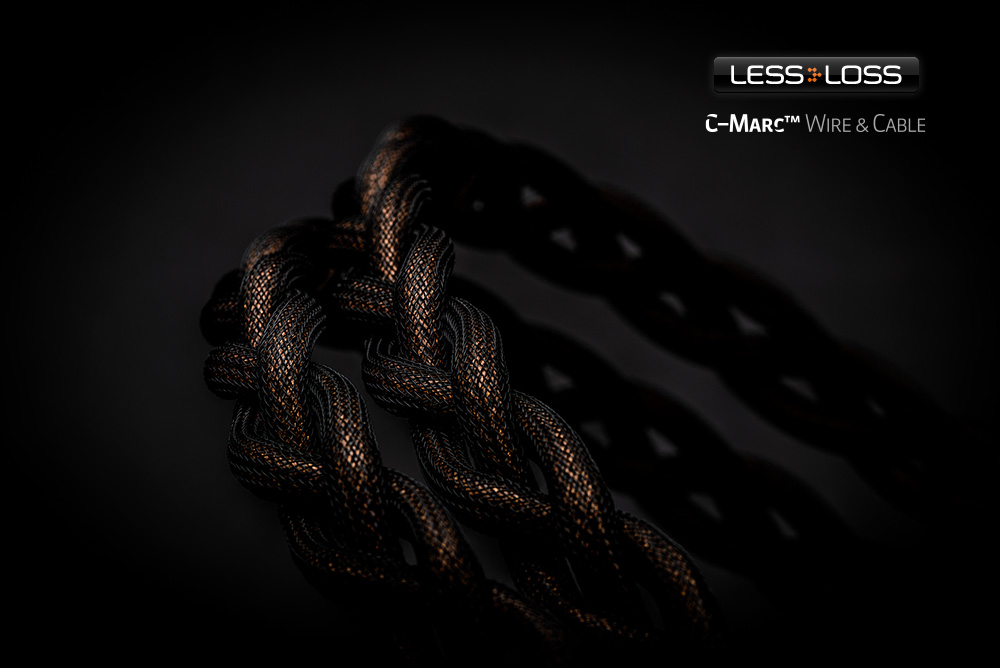
C-MARC stands for Common-Mode Auto-Rejecting Cable, and it is a type of litz wire built around the humbucking principle.
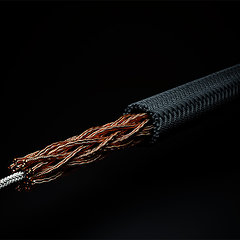
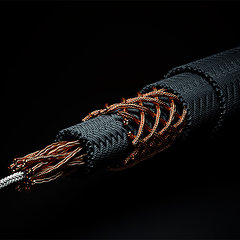
Every strand's clockwise turn is matched by a corresponding counter-clockwise turn of exactly mirrored diameter and step. The two counter-polarised coils are superposed, and the whole arrangement is then repeated at a second, larger scale. Noise induced equally in both halves cancels itself out in the geometry.
There are no filter components anywhere in this. Nothing is added to the signal path, and nothing in it can alter the original power's dynamic availability.
Why litz wire, and why not ordinary litz?
Litz wire has three advantages over plain multi-stranded or solid core wire, and one disadvantage that C-MARC was created to solve.
The advantages: a far greater ratio of surface area to cross section, which means less phase smearing between low and high frequencies; no distortion from strand jumping or the diode effects that arise where the oxide layers of bare adjacent strands touch loosely; and far greater flexibility and safety than solid core wire of the same cross section.
The disadvantage is structural. Traditional litz is bunched and then twisted in a single direction, which turns the bundle into an elongated series of coils of differing diameters. In other words, an inductor.
C-MARC counter-winds instead, so that no net coil is formed. You keep every benefit of litz construction and lose the only disadvantage that came with it.
What about the plugs?
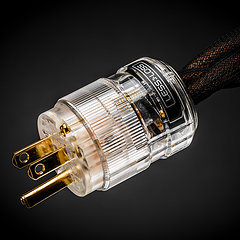
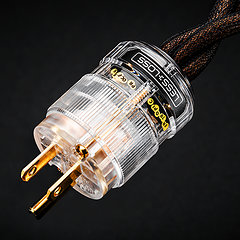
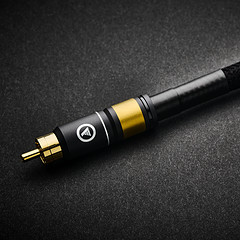
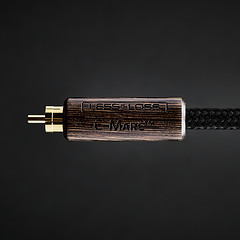
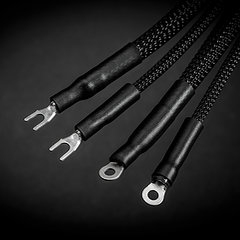
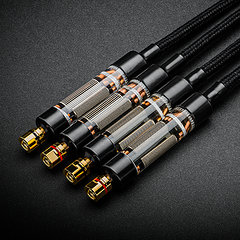
Both ends of a C-MARC power cable are chosen for highest standards, and both are cryogenically treated.
The housings are crystal clear polycarbonate, chosen for zero coloration. The contacts are highly pure, fully gold-plated copper, not brass. Cryogenic treatment is used to release the structural tensions that manufacturing puts into the metal, and the contact springs are deliberately over-engineered: they grip harder than anything else on the market.
At the wall, the plug follows your country's standard. The North American version is the IeGO Dreamworks Ti2000(M) 8085CT-Gu, whose gold-plated contacts are 99.99% pure copper sourced from Furukawa. The continental European Schuko version is the IeGO Dreamworks Ti2400(M) 8085CT-Gu, with gold-plated tellurium copper of 99.97% purity sourced from KME. The Schuko option costs nothing extra.
UK and Australian plugs are available as a custom order, for which we use Furutech.
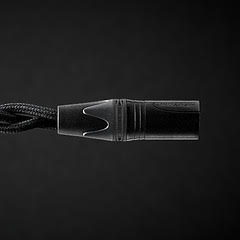
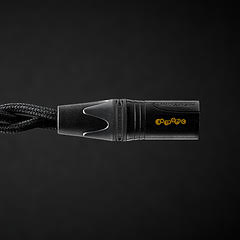
At the component end you choose 15A/C13 or 20A/C19, depending on what your equipment takes.
What is burn-in, and what should you expect?
Burn-in is a strange phenomenon in which new cables pass through a series of transitional performance phases before settling.
One day the sound may be brittle and coarse. Another day it may be rubbery and elastic. You may go through a phase where the bass submerges everything as though you were listening underwater, then a period where the bass seems too weak against the mids and treble. Eventually the two extremes converge into a stable, mature tonal balance. From that point on, everything flows most naturally.
How plainly you hear any of this depends on your system and your room. A room with ceramic tiles and large areas of exposed glass behaves as an echo chamber and will mask the effect considerably. A well set-up system in a well-treated room will show you every stage of it.
We describe it this way because that is what it is. We have been watching it closely for twenty years and we still call it strange.
Prime, Classic or Stellar?
The three models differ in how much copper they carry and in whether the Entropic Process treatment is applied.
| Prime | Classic | Stellar | |
|---|---|---|---|
| Copper strands, clockwise | 96 x 3 | 192 x 3 | 288 x 3 |
| Copper strands, counter-clockwise | 96 x 3 | 192 x 3 | 288 x 3 |
| Mercerised cotton strands | 24 x 3 | 376 x 3 | 376 x 3 |
| Total strands | 648 | 2,280 | 2,856 |
| Total conductive cross section | 7.069 mm² | 14.137 mm² | 21.206 mm² |
| Entropic Process | not available | optional | always included, carried out twice |
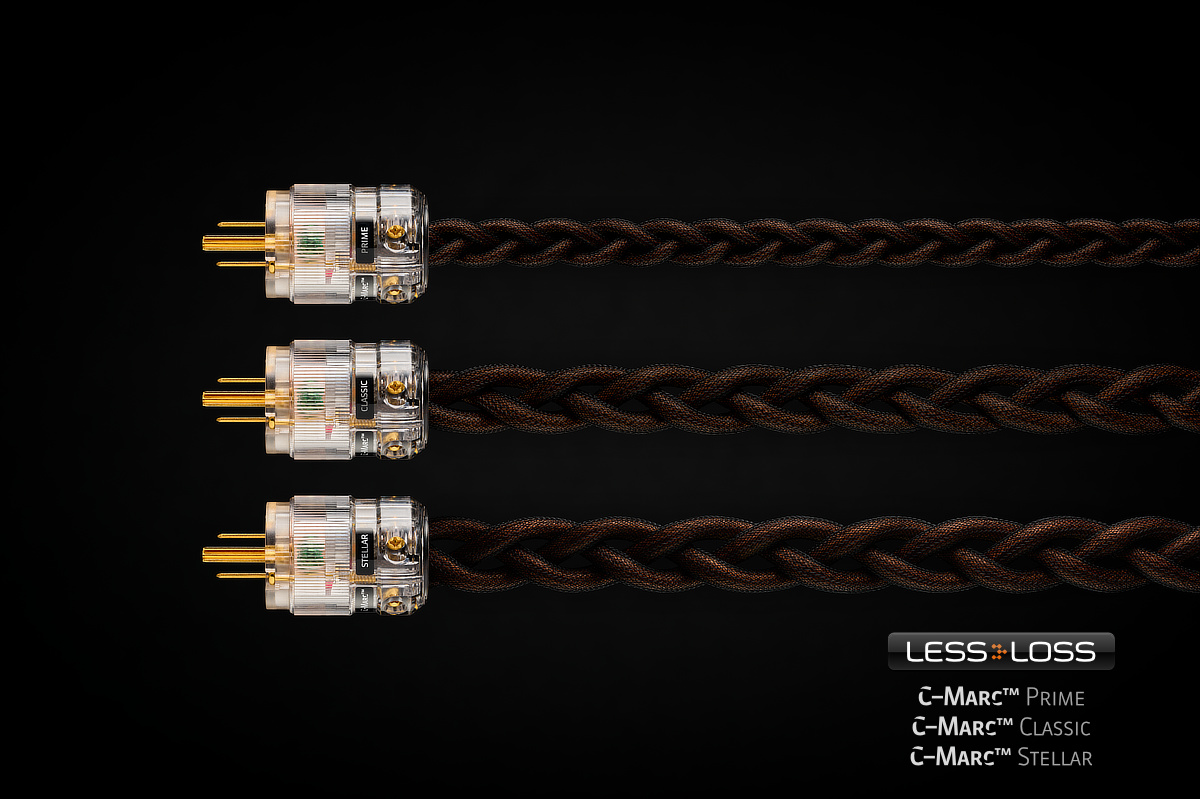
The geometry is identical in all three. Every strand is 0.125 mm, every clockwise turn is mirrored by a counter-clockwise turn of the same diameter and step, and every model is braided by hand.
What changes is scale. Prime carries one complete dual fractal braid per line. Classic carries two. Stellar carries 1.5x as much copper as Classic, and arrives with a double Entropic Process treatment as standard rather than as an option.
Prime is the one model for which Entropic Process is not offered at all. If you begin there and want it later, we upgrade Prime cables to Classic Entropic Process.
 C-MARC Prime
One dual fractal braid per line
 C-MARC Classic
Two braids, Entropic Process optional
 C-MARC Stellar
1.5x the copper of Classic, double Entropic Process
Where C-MARC cables are built
All C-MARC power cables are hand-braided in Lithuania, in the European Union, and shipped worldwide at no charge.