







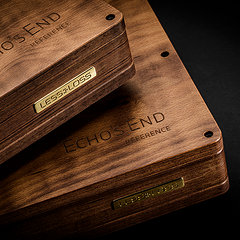
Laminar Streamer ultimate SD card player development
Thursday 05 June, 2014
A summarized history of the development so far

Philosophy of design
We first pinpointed and defined the strengths and weaknesses of both disc-spinning hardware versions and computer audio versions of digital audio playback machines. We came to the conclusion that, clearly, two lines of engineering were converging into some yet-to-be-built device. The CD players were becoming more robust and better sounding, and computer audio was being stripped of services and functions which had nothing to do directly with the audio stream's timing. Thus, we mated these two tendencies and named it the Laminar Streamer.
Clocking
We started with detailed analysis of high performance clocking solutions and came to the realization that the very best clocking solution is the very simplest. This means that re-clocking schemes should not be used, but that the initial clock oscillator must be of extraordinary quality. We examined pretty much all available clock options and different clock schematics, and took into account our learned experience from having developed the excellent DAC 2004 Master Clock DAC back in the early 2000s.

A picture of some of the clock oscillators we compared for performance while integrating them into our purpose-built system. When we designed our operating system to run off of the audio clock itself, which needs two base frequencies to provide support for all available audio sampling rates, we were running into unchartered territory. Until this project, all such operating system solutions, even the top-quality professional systems, were run and synchronized by Phase Locked Loops, which add relatively large quantities of Jitter to the digital audio stream. (When you say "large" in this context, it is always important to know who you are talking to: a marketer or an enthusiast who craves genuine information. You know how it is: everything is relative, except for the strange out-lying die-hard enthusiasts such as ourselves. We don't like compromised sound!)
Custom Operating System built from scratch
At the same time we developed and wrote our own operating system for the device. Compare our 30 pages of custom written code to the thousands and thousands of pages which run popular operating systems such as Windows, MAC OS and Linux. Thus, we had the advantage of custom coding and custom building a system which would be centered only around the ultimate quality performance of real-time clock and data streaming for audio purposes. In doing so, all other extraneous functionality would be absent from the system to begin with. Little did we know how deeply into the bits we would thereby be hearing.
After we made several prototype units we felt we had maximized what we could draw in terms of quality performance from the electronics themselves. We now turned our efforts to the design.
Design inspiration
Once we had the running electronic schematic, which contained only one clock source, we realized how obviously audible the influence of the build quality and materials was to become. Weight and microvibration absorption were crucial elements which we engineered into the design using Panzerholz mated directly with chromium plated steel which would not be allowed to ring. (You may care to see our studio experiments with Panzerholz vs. Aluminum for some obvious comparisons.)

The attention to nuts-and-bolts engineering was something we learned from well-known classical CD transport designs which had been becoming ever more sophisticated in their vibration control, not only because of the optical element, as it turns out. The same if not more applies to memory-based audio due to the electromagnetic absence of motor control noise.
Physical design materials and basics
After we had the main materials worked out, we implemented a profound shielding of the PSU from the sensitive circuitry via solid steel of several mm thickness. It was now time to work on design aesthetics. It is no easy task to design for looks and functionality all at once, but difficult tasks require only hard work, and so we began. We canned the "box" design and worked with our functional design incorporating perfect stability on three points, perfect triangular symmetry, as well as maximum visibility of the physically and electromagnetically effective design materials such as the thick steel and dense Panzerholz.
First design sketches

Integration of design ideals with design ideas
After completion of the concept, we turned to the minutiae of making it work with our existing electronic conception involving microvibration control of every single element in the Laminar Streamer.


Conversion to milling machine language
When we had the 3D files ready, we then had to have them calculated into 3D strategy files for the milling machines. To test, we milled a couple using MDF, the most ubiquitous and probably worst sounding wood-based material in the world, but easy to mill and good for modeling.


Performing using real-world materials
After checking for compliance, we were ready to mill our first Panzerholz version. Panzerholz is so much more costly (about 20x) and so much more dense (it actually sinks in water) that any mistake here would set us far back. Here are pictures of the first milling operations, fresh off the mill:


Unique Panzerholz lacquering procedure
Preparing these Panzerholz parts for lacquering is the work of a human mind and skilled hands. Effort is made to prepare the surfaces to perfection and to dye the Panzerholz in a pleasing and aesthetic way. As far as we know, we are the only ones in the world to have chosen to work Panzerholz into a 3D aesthetically pleasing design element while at the same time using it as a structural vibration controlling chassis. Pictures of this process follow.


Integrating functional material as design element (less is more)
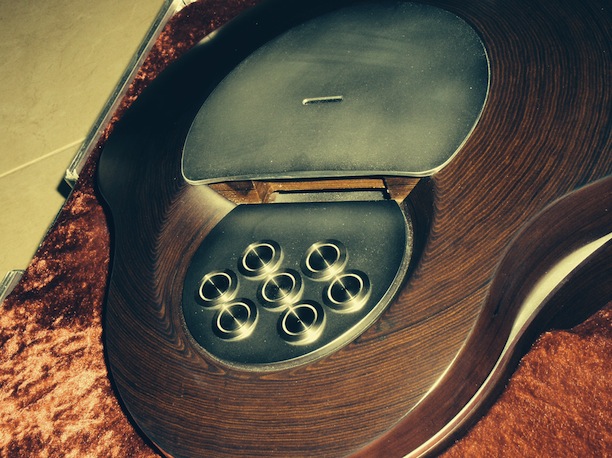
Here is a close up using a professional camera as to the real grain structure of the highly compressed Panzerholz (from our Firewall product). The crude workshop snapshots above cannot reveal the actual detail of the look.

Hello world! First assembly of steel and Panzerholz
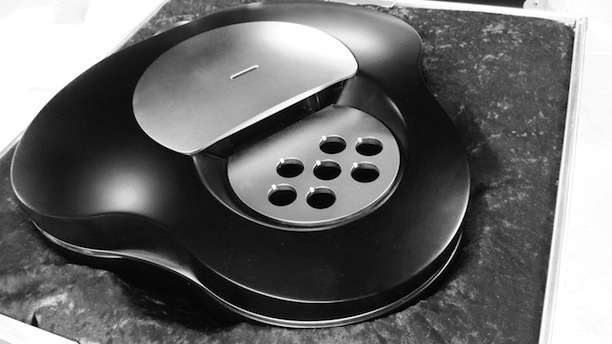
After receiving the precision milled, brushed, sand blasted and chromium plated steel parts, of which there are five per Laminar Streamer, we were finally able to put together the first unit (minus tempered display glass, connectors, steel buttons and other internals. This resulted in our first opportunity to get real snapshots of the device taken, and here they are.


Probably a new world record
In this form it weighs about 54 lbs (25 kg). Of course you will have read about certain Japanese manufacturers of legendary CD spinning transports extolling the virtues of the ratio between the CD disc's light weight and heavy weight of the entire contraption. Well, you now see that we've taken that legendary ratio to completely new heights!
A darker dye is probably better
We ran some experiments to darken the dye, and we believe it looks better this way, over all.


Protection from the elements (of hatred)
Finally, we completed our first custom built flight cases to ensure the safe transport this fine and weighty device. One thing all audiophiles must constantly come to terms with is the fear of having our prized and beloved gear battered to pieces in the shipping channels. Every one of us has our horror stories. I've had mine, too. Overnight express of a friend's hand built amp turned into its overnight disintegration. Didn't buy insurance. As the Germans say: "Selber schuld…" (I still childishly suspect that there's a secret conspiracy in the shipping agencies aimed against audiophiles alone.)

And what we still have to do
We are currently finishing up the silk screening job and hand assembling the first production main circuit boards.
Here you can see how the Panzerholz will make direct contact to a generous portion around the edges of the circuit board. The anti-vibration qualities of the Panzerholz material will thus be utilized to the extreme. The round holes are for the robust industrial specced control buttons.

Thick steel will immediately surround the SD card upon insertion. You can see the thick round top plate here, viewed from the inside of the device. (This is the underside of the plate.) It is quite amazing how it rings like a bell because it is inherently very resonant material, but when mated to the Panzerholz, even without using any bolts, it is dead silent and doesn't exhibit even the slightest ringing tail. It sounds like a rock buried in the earth.

The same goes for the large, main plate of steel. The aim here is to separate the low frequency EM fields coming from the transformer from the main circuitboard, which will be on the other side of it. Basically, what you see here is what the main circuit board will see when it "looks" at the transformer -- a centimeter thick steel barrier which will absorb all of the low frequency fields. The holes will be full of steel bolts, too, so nothing will get through.

This is an example of the bolts I mean. Here you see how they hold the round leg tightly to the Panzerholz above. Again, I emphasize the uncanny feeling that metal makes absolutely no sound when mated tightly to the Panzerholz. Not even a very short ring, which you'd expect to hear upon rapping on it.

The leg will make contact with the furniture in only three places, for ultimate stability in stance and to minimize any possible micro-vibration at the foot-table interface.

The control buttons, likewise, will have no chance at adding even the slightest parasitic micro-vibration to the unit. The Play button will glow dark blue when engaged, but in Laminar Mode, all power to both the visual display and to the diode in the Play button itself will be disengaged. Even the operating system, at that point, will not know anything about the SD data except the very sample it is currently on, and where the next one is. At that point it will be absolutely smooth sailing, and the Laminar Streamer will be completely in its element.
.jpg)
The main Laminar Streamer page is here.
Philosophy of design
We first pinpointed and defined the strengths and weaknesses of both disc-spinning hardware versions and computer audio versions of digital audio playback machines. We came to the conclusion that, clearly, two lines of engineering were converging into some yet-to-be-built device. The CD players were becoming more robust and better sounding, and computer audio was being stripped of services and functions which had nothing to do directly with the audio stream's timing. Thus, we mated these two tendencies and named it the Laminar Streamer.
Clocking
We started with detailed analysis of high performance clocking solutions and came to the realization that the very best clocking solution is the very simplest. This means that re-clocking schemes should not be used, but that the initial clock oscillator must be of extraordinary quality. We examined pretty much all available clock options and different clock schematics, and took into account our learned experience from having developed the excellent DAC 2004 Master Clock DAC back in the early 2000s.
A picture of some of the clock oscillators we compared for performance while integrating them into our purpose-built system. When we designed our operating system to run off of the audio clock itself, which needs two base frequencies to provide support for all available audio sampling rates, we were running into unchartered territory. Until this project, all such operating system solutions, even the top-quality professional systems, were run and synchronized by Phase Locked Loops, which add relatively large quantities of Jitter to the digital audio stream. (When you say "large" in this context, it is always important to know who you are talking to: a marketer or an enthusiast who craves genuine information. You know how it is: everything is relative, except for the strange out-lying die-hard enthusiasts such as ourselves. We don't like compromised sound!)
Custom Operating System built from scratch
At the same time we developed and wrote our own operating system for the device. Compare our 30 pages of custom written code to the thousands and thousands of pages which run popular operating systems such as Windows, MAC OS and Linux. Thus, we had the advantage of custom coding and custom building a system which would be centered only around the ultimate quality performance of real-time clock and data streaming for audio purposes. In doing so, all other extraneous functionality would be absent from the system to begin with. Little did we know how deeply into the bits we would thereby be hearing.
After we made several prototype units we felt we had maximized what we could draw in terms of quality performance from the electronics themselves. We now turned our efforts to the design.
Design inspiration
Once we had the running electronic schematic, which contained only one clock source, we realized how obviously audible the influence of the build quality and materials was to become. Weight and microvibration absorption were crucial elements which we engineered into the design using Panzerholz mated directly with chromium plated steel which would not be allowed to ring. (You may care to see our studio experiments with Panzerholz vs. Aluminum for some obvious comparisons.)
The attention to nuts-and-bolts engineering was something we learned from well-known classical CD transport designs which had been becoming ever more sophisticated in their vibration control, not only because of the optical element, as it turns out. The same if not more applies to memory-based audio due to the electromagnetic absence of motor control noise.
Physical design materials and basics
After we had the main materials worked out, we implemented a profound shielding of the PSU from the sensitive circuitry via solid steel of several mm thickness. It was now time to work on design aesthetics. It is no easy task to design for looks and functionality all at once, but difficult tasks require only hard work, and so we began. We canned the "box" design and worked with our functional design incorporating perfect stability on three points, perfect triangular symmetry, as well as maximum visibility of the physically and electromagnetically effective design materials such as the thick steel and dense Panzerholz.
First design sketches
Integration of design ideals with design ideas
After completion of the concept, we turned to the minutiae of making it work with our existing electronic conception involving microvibration control of every single element in the Laminar Streamer.
Conversion to milling machine language
When we had the 3D files ready, we then had to have them calculated into 3D strategy files for the milling machines. To test, we milled a couple using MDF, the most ubiquitous and probably worst sounding wood-based material in the world, but easy to mill and good for modeling.
Performing using real-world materials
After checking for compliance, we were ready to mill our first Panzerholz version. Panzerholz is so much more costly (about 20x) and so much more dense (it actually sinks in water) that any mistake here would set us far back. Here are pictures of the first milling operations, fresh off the mill:
Unique Panzerholz lacquering procedure
Preparing these Panzerholz parts for lacquering is the work of a human mind and skilled hands. Effort is made to prepare the surfaces to perfection and to dye the Panzerholz in a pleasing and aesthetic way. As far as we know, we are the only ones in the world to have chosen to work Panzerholz into a 3D aesthetically pleasing design element while at the same time using it as a structural vibration controlling chassis. Pictures of this process follow.
Integrating functional material as design element (less is more)
Here is a close up using a professional camera as to the real grain structure of the highly compressed Panzerholz (from our Firewall product). The crude workshop snapshots above cannot reveal the actual detail of the look.
Hello world! First assembly of steel and Panzerholz
After receiving the precision milled, brushed, sand blasted and chromium plated steel parts, of which there are five per Laminar Streamer, we were finally able to put together the first unit (minus tempered display glass, connectors, steel buttons and other internals. This resulted in our first opportunity to get real snapshots of the device taken, and here they are.
Probably a new world record
In this form it weighs about 54 lbs (25 kg). Of course you will have read about certain Japanese manufacturers of legendary CD spinning transports extolling the virtues of the ratio between the CD disc's light weight and heavy weight of the entire contraption. Well, you now see that we've taken that legendary ratio to completely new heights!
A darker dye is probably better
We ran some experiments to darken the dye, and we believe it looks better this way, over all.
Protection from the elements (of hatred)
Finally, we completed our first custom built flight cases to ensure the safe transport this fine and weighty device. One thing all audiophiles must constantly come to terms with is the fear of having our prized and beloved gear battered to pieces in the shipping channels. Every one of us has our horror stories. I've had mine, too. Overnight express of a friend's hand built amp turned into its overnight disintegration. Didn't buy insurance. As the Germans say: "Selber schuld…" (I still childishly suspect that there's a secret conspiracy in the shipping agencies aimed against audiophiles alone.)
And what we still have to do
We are currently finishing up the silk screening job and hand assembling the first production main circuit boards.
Here you can see how the Panzerholz will make direct contact to a generous portion around the edges of the circuit board. The anti-vibration qualities of the Panzerholz material will thus be utilized to the extreme. The round holes are for the robust industrial specced control buttons.
Thick steel will immediately surround the SD card upon insertion. You can see the thick round top plate here, viewed from the inside of the device. (This is the underside of the plate.) It is quite amazing how it rings like a bell because it is inherently very resonant material, but when mated to the Panzerholz, even without using any bolts, it is dead silent and doesn't exhibit even the slightest ringing tail. It sounds like a rock buried in the earth.
The same goes for the large, main plate of steel. The aim here is to separate the low frequency EM fields coming from the transformer from the main circuitboard, which will be on the other side of it. Basically, what you see here is what the main circuit board will see when it "looks" at the transformer -- a centimeter thick steel barrier which will absorb all of the low frequency fields. The holes will be full of steel bolts, too, so nothing will get through.
This is an example of the bolts I mean. Here you see how they hold the round leg tightly to the Panzerholz above. Again, I emphasize the uncanny feeling that metal makes absolutely no sound when mated tightly to the Panzerholz. Not even a very short ring, which you'd expect to hear upon rapping on it.
The leg will make contact with the furniture in only three places, for ultimate stability in stance and to minimize any possible micro-vibration at the foot-table interface.
The control buttons, likewise, will have no chance at adding even the slightest parasitic micro-vibration to the unit. The Play button will glow dark blue when engaged, but in Laminar Mode, all power to both the visual display and to the diode in the Play button itself will be disengaged. Even the operating system, at that point, will not know anything about the SD data except the very sample it is currently on, and where the next one is. At that point it will be absolutely smooth sailing, and the Laminar Streamer will be completely in its element.
The main Laminar Streamer page is here.